If you run a roofing company in metro Atlanta, you already know the pattern. A line of severe thunderstorms rolls across from Alabama on a Tuesday afternoon, hail pounds Cobb and Cherokee counties for eleven minutes, and by Wednesday morning half a dozen companies are pulling permits and stacking shingles in driveways.
Some of those companies are yours truly, booked solid for six weeks. Others are sitting in the office wondering why the phone didn’t ring, even though their crews are better, their warranties are stronger, and they’ve been serving the same neighborhoods for fifteen years.
The difference almost never comes down to craftsmanship. It comes down to visibility and speed. When a homeowner in Marietta or Decatur discovers water staining the ceiling at 9 p.m., they grab their phone, type “emergency roof repair near me,” and call one of the first names they see. The company that shows up first and answers first gets the job.
This article breaks down exactly how Atlanta roofing companies can capture more emergency and storm-damage work, from hail damage roof inspections to 24-hour emergency roof tarping. If your schedule has gaps after storm season while other companies are turning work away, the fixes below are where to start.
Why Do Some Atlanta Roofers Get Flooded With Storm Calls While Others Wait By the Phone?
Metro Atlanta generates storm-damage roofing work nearly year-round, and it comes in several distinct waves.
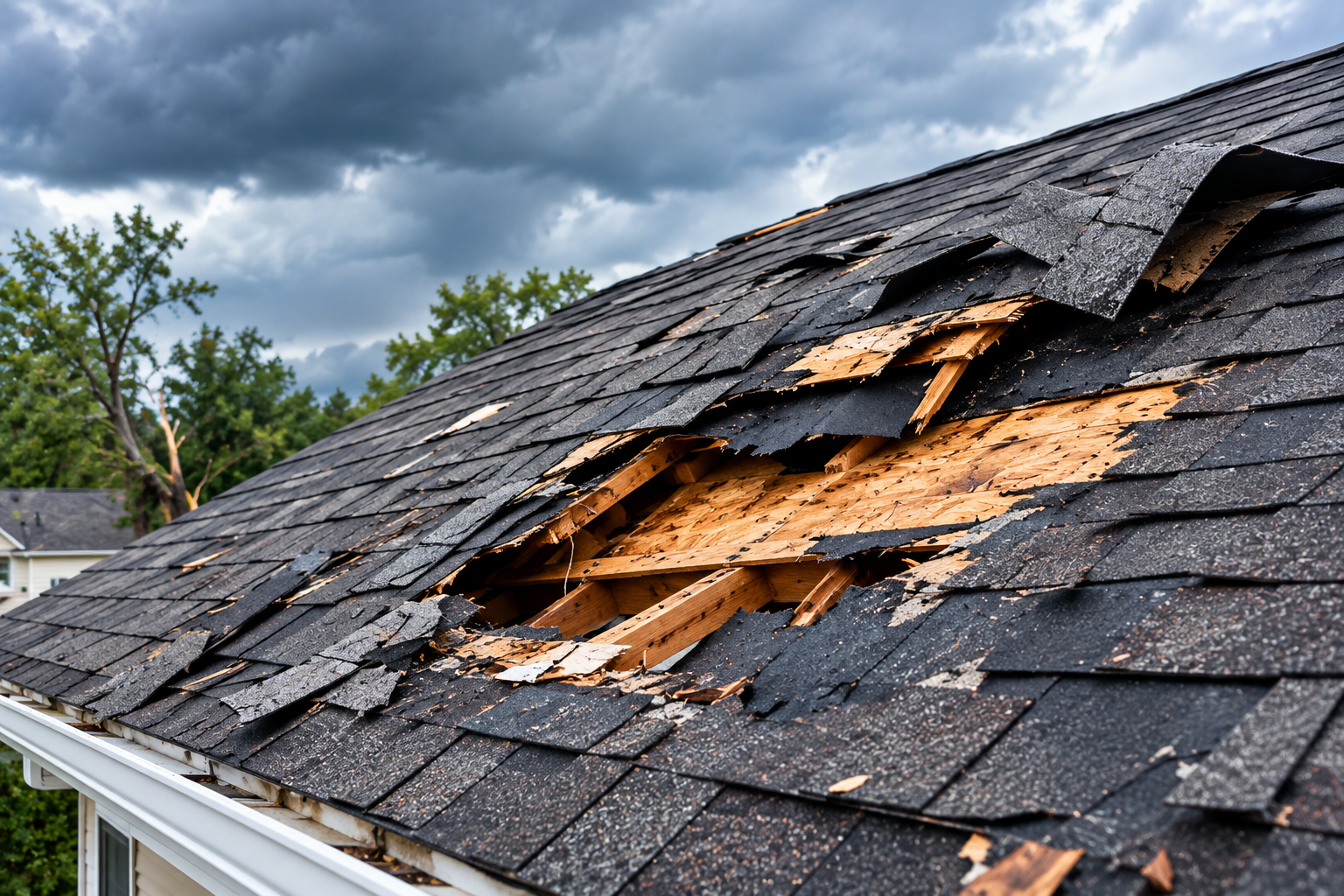
Spring brings the most severe hail. From roughly March through May, supercells moving in from the west regularly drop hail across Paulding, Douglas, Cobb, Cherokee, and north Fulton counties, leaving granule loss, bruised shingles, dented gutters, and damaged soft metals. Summer brings straight-line winds and the pop-up thunderstorms that snap limbs off mature water oaks and loblolly pines and drop them straight through roof decking. Late summer and fall bring tropical storm remnants pushing up from the Gulf, saturating the ground until shallow-rooted trees topple. And every few winters, an ice event adds weight, ice damming, and gutter failure to the mix.
The demand is there. So why do some companies capture it while others don’t?
Because storm work is won before the storm hits. When severe weather crosses the metro, homeowners aren’t researching for three days and collecting five bids. They’re searching once, on a phone, often in a panic, and calling whoever appears credible and available. If your roofing company isn’t already ranking in Google Maps, already visible in local search results, and already reachable after hours, you’re invisible at the exact moment demand peaks.
Because missed calls are the single biggest leak in the roofing business. A homeowner with active water intrusion will not leave a voicemail and wait. They dial the next result. Every unanswered storm call is a $12,000 to $30,000 job handed to another company.
Because most roofing websites aren’t built for urgency. A homeowner standing in the driveway looking at a tarp-worthy hole does not want to browse an “About Us” page. They want a phone number they can tap, proof you’re insured and local, and a promise that someone will be out today.
The roofers who stay busy after every hailstorm have built a system: strong local visibility, instant response, and a website that converts panic into a scheduled inspection. The good news is that every piece of that system can be built, and it doesn’t require being the biggest company in Atlanta.
How Do I Show Up on Google Maps When Homeowners Search “Emergency Roof Repair Near Me”?
For emergency roofing work, the Google Maps results, often called the map pack or local pack, are the most valuable real estate on the internet. When someone searches “emergency roof repair Atlanta GA,” “roof leak repair Decatur GA,” or “storm damage roof repair Marietta,” the three businesses shown on the map get the overwhelming majority of the phone calls. Many homeowners never scroll past them.
Your position there is driven almost entirely by your Google Business Profile, and most roofing companies leave easy wins on the table.
Start with categories and services. Your primary category should be set correctly, with relevant secondary categories added. Then list every service individually: emergency roof repair, roof leak repair, hail damage inspection, wind damage repair, emergency tarping, roof replacement, gutter replacement, and insurance claim assistance. Each service listing is another chance to match a search.
Define your service areas honestly and strategically. Listing every county in north Georgia dilutes your relevance. Focus on the areas you can actually reach fast, then expand as you build strength.
Post like the storm is happening. Google rewards active profiles, and homeowners notice them. Post a storm-response update when severe weather is in the forecast, post again immediately afterward confirming you’re dispatching crews, and post photos of completed emergency tarping and repairs. A profile that was last updated eleven months ago signals a business that might not answer the phone.
Load it with real photos and video. Drone shots of hail-damaged shingles, before-and-after roof replacements, crews tarping a roof in the rain, a tree removed from a roof deck. This is proof, and proof converts.
Build a review engine. Reviews are among the strongest signals for local ranking and the deciding factor for most homeowners. Ask every single customer, ideally by text with a direct link, right when the job is finished and satisfaction is highest. Encourage reviews that mention the specific service and the city, because a review that says “they replaced our hail-damaged roof in Sandy Springs and handled the insurance claim” does double duty for rankings and trust. Google’s own guidance on improving local ranking confirms that relevance, distance, and prominence all matter, and reviews feed directly into prominence.
Keep your name, address, and phone number identical everywhere. Inconsistent listings across directories quietly undermine your rankings.
This is the core of local SEO for Atlanta roofing companies, and it’s the highest-return work most roofers can do. Unlike shared lead services that sell the same homeowner to four companies, a call generated from your Google Business Profile belongs to you alone. No bidding war, no racing three competitors to the phone, no paying for a lead that was already claimed.
What Should My Website Do to Capture Storm-Damage Leads at 9 P.M.?
Ranking gets a homeowner to your website. Your website decides whether they call you or go back to the search results.
Here’s the scenario your site has to win: it’s dark, it’s raining, there’s a bucket in the hallway, and someone is scrolling on a cracked phone screen with about ten seconds of patience. Most roofing websites lose that homeowner without the owner ever knowing it happened.
A tap-to-call number must be visible on every screen, at the top. Not in the footer. Not on a contact page. At the top, always, as a button.
Speed is non-negotiable. A site that takes six seconds to load on mobile data loses the job to one that loads in two.
Emergency services need their own dedicated pages. A single page listing everything you do won’t rank for anything specific. You need separate, detailed pages for emergency roof repair, storm damage roof repair, hail damage roof inspection, wind damage repair, emergency roof tarping, roof leak repair, and insurance claim assistance. Then those pages should be tied to the places you serve, so you can compete for long-tail searches like “emergency roof tarping Smyrna GA” or “hail damage roof inspection East Cobb.”
Your quote form should take under a minute. Name, address, phone, what happened, and the ability to upload photos of the damage. Photo uploads are especially valuable in storm work, because you can triage severity and prepare before dispatching a crew.
Trust signals have to be immediate and visible. After every major Atlanta storm, out-of-area operators flood the metro, and local homeowners have heard the horror stories. Display proof of general liability and workers’ compensation coverage, manufacturer certifications, warranty details, years serving the Atlanta area, real crew photos, and Google reviews. A homeowner choosing between two unfamiliar roofers picks the one that looks unmistakably legitimate and local.
Speak directly to the insurance claim process. This is where huge numbers of roofers lose emergency work. Homeowners are confused and anxious about deductibles, adjusters, depreciation, and supplements. A clear, plain-language page explaining how a storm-damage claim typically works, what to document, what to expect from the adjuster meeting, and how your company supports the process will out-convert a competitor’s generic “we work with all insurance companies” line every single time. It also attracts long-tail searches like “insurance claim roofing contractor Atlanta” and “does insurance cover hail damage roof Georgia.”
At Get Found Atlanta, every site we build uses our own high-converting contractor template, developed specifically for roofing and tree service companies in this market. The structure, calls to action, and conversion elements are already proven, so you’re not paying for experiments. Learn more about our website services, or if your current site needs rebuilding from the ground up, see our website redesign option.
One more thing that costs Atlanta roofers more jobs than anything else: answering the phone. Build a system that guarantees a human response after hours during storm season, whether that’s a rotating on-call line, an answering service, or automatic text-back on missed calls. The most beautiful website in Cobb County can’t help you if the call goes to voicemail.
How Do I Compete With Out-of-Town Storm Chasers Rolling Into Metro Atlanta?
Every Atlanta roofer knows the feeling. A significant hail event hits, and within 48 hours there are unfamiliar trucks with out-of-state plates working every street in the affected neighborhoods, knocking doors while your crews are still finishing last week’s jobs.
You can’t out-hustle a twenty-person door-knocking team on foot. But you can beat them where it actually matters, because you have advantages they will never have.
You’re permanently local, and you can prove it. Transient operators disappear after the season ends. Your warranty means something because you’ll still be here in five years. Say this explicitly on your website, in your Google Business Profile description, and in every review response: locally owned, serving metro Atlanta since [year], here long after the storm.
You have the local review history they can’t fake. A roofing company with 150 Google reviews spread across Marietta, Roswell, Alpharetta, Decatur, and Smyrna, accumulated over years, is dramatically more credible than a new listing with twelve reviews from three states.
You show up in search while they’re still walking. Door knocking reaches one street at a time. Ranking in the map pack for “storm damage roof repair” across your service area reaches every homeowner in the affected zone, simultaneously, at the moment they’re actively looking for help. This is the single greatest structural advantage a local roofer has.
You can be there first. Your crews are already in the area. Offering same-day emergency tarping and a fast damage assessment, and saying so prominently, beats a stranger at the door for most homeowners.
You can educate. Content that helps homeowners understand what hail damage actually looks like, how to document damage safely for an insurance claim, what to do immediately after a tree falls on a roof, and how to verify a contractor is properly insured builds trust before anyone knocks. It also captures valuable long-tail searches like “how to tell if my roof has hail damage” and “what to do if a tree falls on my house in Atlanta.” Homeowners who read your guidance already feel like they know you.
Pair that content with real video. Roof work is visual, and a short clip of your crew tarping a roof in a downpour or walking a homeowner through hail-damaged shingles builds more trust than any paragraph. Video also gives you another way to rank, since well-optimized videos can surface in both YouTube and Google results for local searches. It’s an advantage most Atlanta roofers still aren’t using.
Should I Run Ads, Do SEO, or Both to Get More Hail and Wind Damage Jobs?
The honest answer is both, with different jobs to do.
Local SEO and your Google Business Profile are the foundation. They take a few months to build momentum, but they produce exclusive, unpaid calls that keep coming, and the cost per booked job drops over time. This is the asset that makes you the company Atlanta homeowners find first, storm after storm, year after year.
Paid ads are the accelerator. Google Ads and Local Services Ads can put you at the top of results within days, which matters enormously in storm work where demand appears suddenly and disappears within weeks. The key is disciplined management: tight geographic targeting so you’re not paying for clicks outside your service area, the right service categories, negative keywords to filter out unqualified searches, and budgets that flex with the weather.
The winning play for Atlanta roofers is to have pre-built emergency campaigns ready to switch on the moment severe weather crosses the metro. When the National Weather Service office in Peachtree City issues warnings, you increase budget for 48 to 72 hours, capture the surge, then pull back as demand normalizes. Companies that wait until after the storm to build a campaign have already missed the window. Our PPC management service is built around exactly this kind of storm-responsive strategy.
And there’s a third channel most roofers haven’t accounted for yet: AI search. More Atlanta homeowners are now asking AI assistants and reading Google’s AI summaries before they ever click a website. When someone asks, “Who’s a reliable roofer in Atlanta for hail damage?”, those tools pull from businesses with clear, well-structured, consistent information and strong review signals. Thin or messy websites get skipped entirely. Getting your business positioned for those answers is what our AI SEO service is designed to do.
What about shared leads? They can fill an occasional gap, but they’re a poor foundation. You’re buying the same homeowner as several competitors, competing on price before you’ve had a chance to build trust, and paying again every single time. Every dollar spent on owned channels builds equity. Every dollar spent on shared leads rents attention for a moment.
If you’re not sure where your business stands right now, a site audit will show you exactly where you rank, where you’re losing calls, and what’s holding your visibility back.
Related Questions Atlanta Roofers Are Asking
How long does it take to start ranking for storm-damage roofing searches in Atlanta?
Paid ads and Local Services Ads can produce calls within days. Google Business Profile improvements often show movement within a few weeks to a couple of months. Website SEO typically builds over three to six months, then compounds. The critical point: start before storm season, not during it.
Is it worth marketing during the slow months?
Yes, and it’s the best time. Rankings and reviews take months to build, so the work you do in January and February determines whether you capture the March and April hail surge. Slow-season marketing also brings in roof inspections, gutter work, and planned replacements that keep crews working.
Should I target all of metro Atlanta or focus on specific cities?
Focus first. Building real visibility in a cluster of areas you can reach quickly, such as Marietta, Smyrna, and Sandy Springs, or Decatur, East Point, and College Park, produces far more work than spreading thin across the entire metro.
Do Google reviews really affect how many storm calls I get?
Significantly. They influence both your map pack ranking and the homeowner’s final decision. A steady flow of recent, detailed reviews mentioning storm damage, emergency repairs, and specific cities is one of the highest-leverage assets a roofing company can build.
What’s the fastest fix if my phone is quiet right now?
Two things, today. First, make sure every call gets answered, including after hours. Second, complete and activate your Google Business Profile: correct categories, every service listed, real photos, accurate service areas, and a fresh post. Those two changes alone recover jobs most roofers are currently losing without knowing it.
Ready to Be the Roofer Atlanta Calls First?
Storms will keep coming to metro Atlanta. Hail in the spring, wind and fallen trees through the summer, tropical remnants in the fall. The only question is whether homeowners find your company or someone else’s when they start searching.
I’m Gerald Harris, founder of Get Found Atlanta. I’ve been building websites since 2010, grew a YouTube channel to more than 60,000 subscribers, and have spent years helping business owners rank locally on Google and Google Maps. I focus specifically on roofing and tree service companies in the Atlanta metro, so you never have to explain your business, your busy seasons, or how storm demand works. I already know.
I’ll show you where your roofing company ranks today for searches like “emergency roof repair near me” and “storm damage roof repair Atlanta,” where you’re losing calls to other companies, and exactly what it will take to keep your crews booked through every storm season.
Start My Free Consultation or call (704) 996-6472 today. You can also see what other local business owners say on our reviews page.
Get found. Get calls. Grow your Atlanta roofing business.