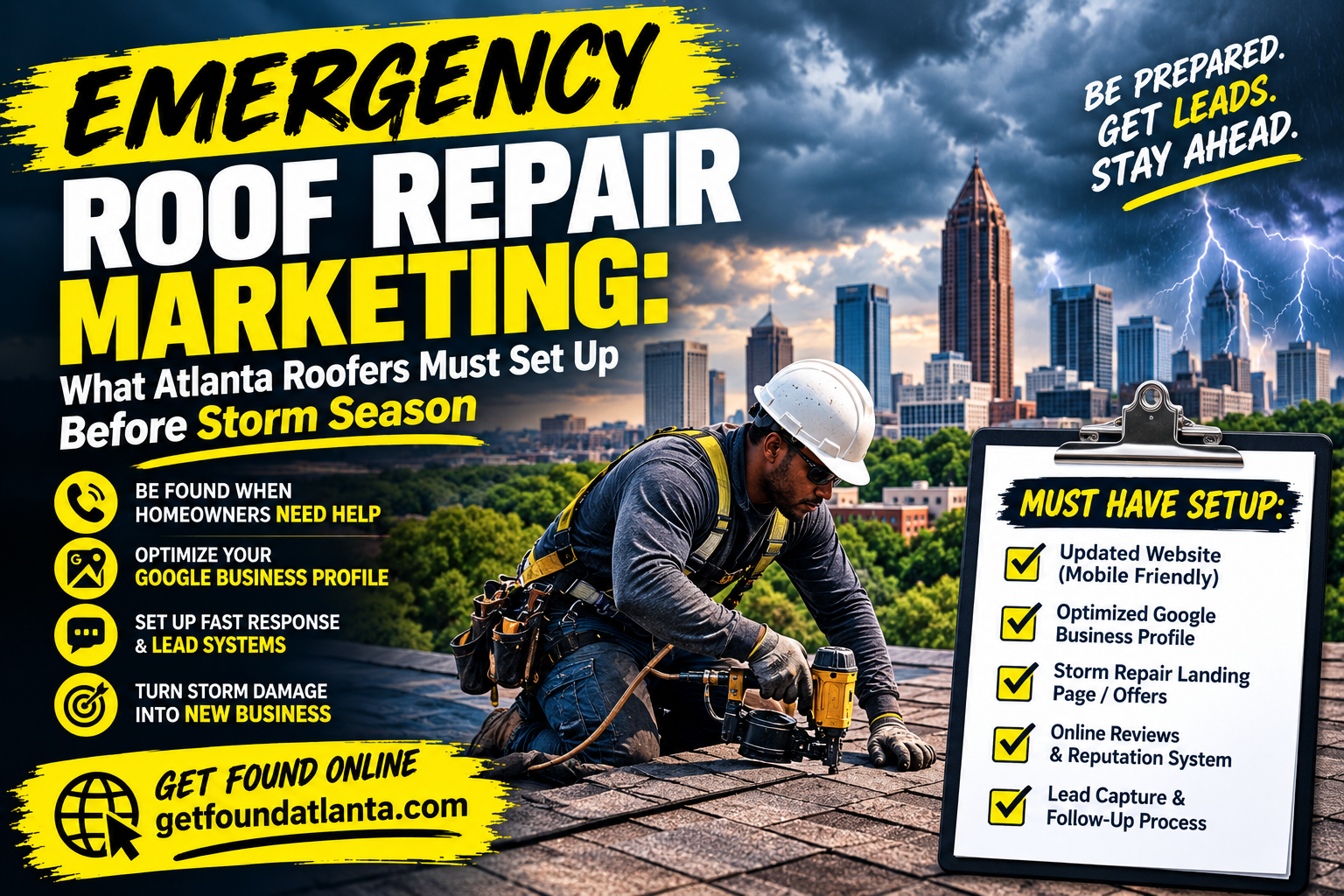
Every spring, the same thing happens across metro Atlanta. A line of severe storms crosses from Alabama, hail rattles through Cobb, Cherokee, and north Fulton for ten or fifteen minutes, and by the next morning thousands of homeowners are searching for help. Some roofing companies are booked for six weeks. Others watch the whole surge pass them by.
The difference almost never shows up on the roof. It shows up in what each company set up before the storm arrived.
Emergency roof repair marketing isn’t something you can build in the 48 hours after a hail event. By then, the homeowners who needed help have already called someone else. Rankings take months to build, Local Services Ads verification takes weeks, and a website can’t be rebuilt overnight. The roofers who win storm season do the work in January and February, so that when the first March supercell rolls through, everything is already live, tested, and ready to catch calls.
This guide walks through the eight pieces every Atlanta roofing company should have in place before storm season, in the order you should tackle them.
Why Atlanta Roofers Have to Prepare Early
Metro Atlanta has more than one storm season. Spring, roughly March through May, brings the most damaging hail, often hitting the northwest suburbs hardest. Summer brings straight-line winds and pop-up thunderstorms that drop mature oaks and pines onto roofs. Late summer and fall bring tropical storm remnants that saturate the ground until trees topple. And every few winters, an ice event adds its own damage.
Demand from these events is sudden and short. A hailstorm can create weeks of work in a single afternoon, and most homeowners make their hiring decision within a day or two. They aren’t comparing five bids over a month. They’re searching once, on a phone, often while water is dripping into a bucket, and calling one of the first companies that looks trustworthy.
That’s also the moment out-of-town storm crews arrive and start knocking doors. Your advantage over them is that you’re local, established, and already visible, but only if your marketing is ready before they show up.
Here’s what to set up.
1. Build a Dedicated Emergency Roof Repair Landing Page
Most roofing websites mention emergency service in a single sentence buried on a services page. That costs jobs. When a homeowner searches “emergency roof repair near me” or “24 hour roof repair Atlanta,” Google wants to show a page built specifically for that need, and the homeowner wants a page that tells them in five seconds that help is on the way.
Your emergency roof repair landing page should do a few things very well.
Put the phone number first. A large, tap-to-call button at the top of the screen, visible without scrolling on a phone. Repeat it after every section.
Say what you do in an emergency. Emergency roof tarping, active leak repair, storm damage stabilization, fallen tree damage, and temporary repairs to prevent interior water damage. Be specific, because specific pages rank and convert better than vague ones.
State your response time and hours honestly. “Same-day emergency tarping across Cobb, Fulton, and DeKalb counties” is far more persuasive than “fast service.” If you answer calls 24/7 during storm events, say so clearly.
Tell homeowners what to do right now. A short list of safe first steps, like moving valuables away from leaks, placing buckets, taking photos of damage from the ground, and staying off the roof, builds trust immediately and positions you as the expert before you’ve even arrived.
Show proof. Licensing and insurance information, years serving the Atlanta area, real photos of your crews tarping roofs, and Google reviews that mention emergency work.
Keep the form short. Name, phone, address, and a photo upload. Nothing more. Someone with water coming through the ceiling won’t fill out twelve fields.
If your current site can’t support a page like this, or loads slowly on mobile, fix it now. Every site Get Found Atlanta builds uses our own high-converting contractor template, which includes emergency pages and tap-to-call built in. If your site needs a full rebuild, our website redesign service handles it.
2. Create a Storm-Damage Service Page (Separate From Emergency Repair)
Emergency repair and storm damage repair sound similar, but they serve different homeowners at different moments.
The emergency page is for the person with an active leak tonight. The storm-damage page is for the homeowner who heard hail last Tuesday, noticed dented gutters, and wants to know if their roof is damaged and whether insurance will cover it. That homeowner is searching things like “hail damage roof inspection Atlanta,” “storm damage roof repair Marietta,” “wind damage roof repair Sandy Springs,” or “does insurance cover hail damage roof in Georgia.”
A strong storm-damage service page covers several things.
What hail and wind damage looks like. Granule loss, bruised or cracked shingles, lifted or missing shingles, dented gutters and vents, and damaged flashing. Photos from real Atlanta jobs make this far more convincing.
Why a professional inspection matters. Hail damage is often invisible from the ground, and small bruises can turn into leaks months later. Many homeowners don’t realize they have damage until it’s too late to file a claim.
How the insurance claim process works. This is where most roofing websites fall short and where you can win. Explain in plain language how a typical claim works: documenting damage, filing with the insurance company, meeting the adjuster, understanding the deductible, and what happens if additional damage is found once work begins. Homeowners are confused and anxious about this process, and the company that explains it clearly earns their trust.
Your inspection offer. A free storm damage roof inspection is one of the most effective calls to action in the industry.
Then, go one step further by creating city-specific versions for your core service areas, such as storm damage pages for Marietta, Smyrna, Sandy Springs, and Decatur. A page that mentions local neighborhoods, the storms that hit that area, and jobs you’ve completed there will outrank a generic page every time. This is the heart of local SEO for Atlanta roofers.
Clear, well-structured storm content also helps you show up in AI search. More homeowners are asking ChatGPT and Google’s AI Overviews questions like “what should I do after hail damages my roof,” and those tools pull from pages that answer questions directly. That’s what our AI SEO work is built around.
Timing matters. New pages take time to get indexed and start ranking, so build these at least two to three months before spring storm season.
3. Get Your Google Business Profile Storm-Ready
When a homeowner searches “roofer near me” after a storm, the three businesses in the Google Maps results get most of the calls. Your Google Business Profile determines whether you’re one of them, and storm season is the worst possible time to discover it’s incomplete.
Before the season starts, walk through your profile and confirm each of these.
Categories. Your primary category should be correct, with relevant secondary categories added.
Services. List every service individually, including emergency roof repair, roof leak repair, storm damage repair, hail damage inspection, emergency tarping, roof replacement, and gutter repair. Each one is another chance to match a search.
Hours. If you offer after-hours emergency response, make your hours reflect it. A profile that shows “Closed” at 9 p.m. tells a homeowner with a leak to call someone else.
Service areas. List the areas you can actually reach quickly. Spreading across every county in north Georgia dilutes your relevance.
Business description. Mention emergency and storm damage services, the areas you serve, and that you’re a locally owned Atlanta company. That last point matters when out-of-town crews are flooding the area.
Posting plan. Prepare storm-response posts in advance so you can publish them within minutes. One goes up when severe weather is forecast, letting homeowners know you’re ready. Another goes up right after the storm passes, confirming crews are dispatching and inspections are available.
Name, address, and phone consistency. Your business information should match exactly everywhere it appears online. Inconsistencies quietly hurt your rankings and your AI search visibility.
Google’s own guidance on improving local ranking points to relevance, distance, and prominence as the main factors. A complete, active profile covers the first and strengthens the third.
4. Prepare Reviews and Photos Before You Need Them
When a homeowner compares three roofers in the map pack after a storm, reviews and photos make the decision. And both take time to build, which is why they belong on your pre-season checklist.
Build review momentum now. Reviews are one of the strongest ranking signals for Google Maps and the biggest trust factor for homeowners choosing between unfamiliar companies. Set up a simple system that sends a text with a direct review link to every customer as soon as the job is complete. Winter and early spring, when you’re doing planned replacements and repairs, is the perfect time to build this habit before the storm rush.
Encourage specific reviews. A review that says “They tarped our roof the same night a tree came down in Smyrna and handled the insurance claim” does more for your rankings and your reputation than “Great job.” You can’t script reviews, but you can ask customers to mention what you did and where.
Respond to every review. It shows homeowners you’re active and engaged, and it’s another chance to mention your services and service areas naturally.
Stock your photo library. Organize photos of hail damage close-ups, storm damage, emergency tarping, completed replacements, crews at work, and your trucks with your branding visible. Upload them to your Google Business Profile regularly, and use them on your emergency and storm-damage pages. Real photos from real Atlanta jobs separate you from the companies that just rolled into town.
Consider short video. A thirty-second clip of your crew tarping a roof in the rain, or walking a homeowner through hail damage, builds trust faster than any paragraph. Those clips can go on your website, your profile, and your social media, and well-optimized videos can also appear in Google and YouTube results for local searches.
5. Create a Call-Answering Plan for Storm Surges
This is the part most roofing companies skip, and it’s where the most money is lost.
You can have the best emergency page in Atlanta, a perfect Google Business Profile, and top-ranked ads. If the phone rings four times and goes to voicemail, the homeowner hangs up and calls the next company. They won’t leave a message and wait. A single missed storm call can be a full roof replacement handed to someone else.
Storm surges overwhelm normal phone systems. A company that usually handles fifteen calls a day might get eighty the morning after hail. Plan for that now.
Decide who answers. Assign specific people to phones during storm events, with backups. If you’re a small company, that might mean you, your office manager, and a family member on rotation.
Set up call forwarding and rollover. Make sure unanswered calls roll to a second and third phone automatically instead of going to voicemail.
Write a short intake script. Name, phone, address, what happened, whether there’s active water coming in, and whether they’ve contacted their insurance company. A simple script keeps calls fast and lets you prioritize true emergencies first.
Plan your triage. Active leaks and trees on roofs get same-day response. Inspections for suspected hail damage get scheduled. Knowing the order in advance keeps your crews focused on the highest-value, most urgent work.
Track every call. Call tracking shows how many calls came in, which ones were missed, and which marketing source produced each one. After storm season, you’ll know exactly where your jobs came from and what’s worth investing in next year.
6. Set Up Emergency Text-Back or an Answering Service
Even with a great plan, some calls will slip through, especially after hours or when every line is busy. That’s where a text-back system or answering service becomes your safety net.
Missed-call text-back sends an automatic text to anyone whose call goes unanswered, something like: “Sorry we missed you. We’re responding to storm calls across metro Atlanta. Reply with your address and what happened, and we’ll get back to you shortly.” Homeowners who might have called the next company now have a reason to wait, and you have their information.
An answering service puts a live person on the line when your team can’t pick up. During storm season, especially overnight, this can be the difference between capturing a job and losing it. Make sure the service has your intake script and knows how to flag urgent calls.
Test everything before the season starts. Call your own number after hours. Let it ring out. See what happens. Many roofers discover their voicemail box is full, their forwarding isn’t working, or their text-back was never turned on, and it’s far better to find out in February than during the first hailstorm.
7. Get Google Ads and Local Services Ads Ready Before You Need Them
Local SEO and your Google Business Profile are the long-term foundation. Paid ads give you speed when demand spikes. But ads aren’t something you can build from scratch the morning after a storm, especially Local Services Ads.
Get Local Services Ads verified early. Local Services Ads appear at the very top of many search results with Google’s verification badge, and you pay per lead rather than per click. But the verification process, including background checks and license and insurance review, can take weeks. If you start in March, you may miss the entire spring hail season. Start in the winter.
Configure your job types and service areas. Make sure emergency and storm-related services are enabled, and that your service areas match where you actually want to work.
Build Google Ads campaigns ahead of time. Create separate campaigns for emergency roof repair and storm damage, with ad copy focused on fast response, local ownership, and free inspections. Build out your keyword lists, including terms like “emergency roof repair,” “roof leak repair,” “hail damage roof repair,” and “storm damage roof inspection,” along with city variations. Add negative keywords to filter out searches like jobs, DIY, and materials.
Point ads to the right pages. Emergency ads should go to your emergency landing page. Storm-damage ads should go to your storm-damage page. Sending everything to your homepage wastes money.
Pause, don’t delete. Once built and tested, pause the storm campaigns so they’re ready to switch on the moment severe weather hits.
Set a surge budget. Decide in advance how much you’ll increase spending for the 48 to 72 hours after a major storm, and how much you’ll pull back as demand normalizes. Making that decision calmly in February is better than making it in a panic in April.
Get Found Atlanta’s SEO management is built around exactly this kind of storm-ready setup, so your campaigns are waiting for the storm instead of the other way around.
8. Use Zip-Code Campaign Targeting After a Hail or Wind Event
Here’s where storm-ready roofers pull ahead. Hail doesn’t hit all of metro Atlanta evenly. A storm might hammer parts of Marietta and Kennesaw and completely miss Decatur. Running ads across the entire metro after a localized storm wastes money on homeowners who have no damage.
Instead, target ads to the specific ZIP codes where the damage happened.
Know where the storm hit. Monitor the National Weather Service office in Peachtree City for warnings as storms move through, and check the Storm Prediction Center’s storm reports afterward to see where hail and wind damage were reported. Your own crews and incoming calls will also tell you quickly which neighborhoods were hit.
Build ZIP code lists in advance. Group the ZIP codes in your service area into clusters ahead of time so you can activate targeting in minutes. For example, an East Cobb cluster might include 30062, 30066, 30067, and 30068. A north Fulton cluster might include Roswell’s 30075 and 30076 and Alpharetta’s 30004, 30005, and 30009. A Kennesaw and Acworth cluster might cover 30144, 30152, 30101, and 30102. When hail hits, you switch on the matching clusters instead of building targeting from scratch.
Raise budgets in the damaged areas only. Concentrate spending where homeowners actually need you. That lowers your cost per lead and puts you in front of the right people.
Match your ad copy to the event. Ads that say “Hail damage in East Cobb? Free roof inspections this week” feel immediate and relevant, and tend to perform better than generic messaging.
Support it with your Google Business Profile. Publish a post about the storm and your availability in the affected areas, and make sure your service area includes them.
Keep your advertising honest. After storms, some operators make exaggerated promises about insurance coverage or deductibles. Avoid claims you can’t back up. Clear, honest messaging protects your reputation and keeps your ads compliant with Google’s policies.
Scale back as demand drops. ZIP-code surges usually last a week or two. Watch your lead volume and cost per lead, and pull budgets back when the surge fades.
Your Pre-Storm-Season Timeline
If you’re wondering when to do all of this, here’s a simple schedule for Atlanta roofers.
November through January: Build or rebuild your emergency and storm-damage pages, plus city-specific versions. Start your Local Services Ads verification. Begin a steady review-request system.
January through February: Complete your Google Business Profile updates, upload photos, and prepare storm-response posts. Build and test your Google Ads storm campaigns and ZIP code clusters. Set up missed-call text-back or an answering service.
Late February: Run a full test. Call your own number after hours, submit your own web form, confirm your forwarding works, and double-check your campaigns are ready to switch on.
March through fall: Watch the forecast, activate campaigns when storms hit, target the affected ZIP codes, post updates, answer every call, and ask every customer for a review.
Not sure where your business stands right now? A free site audit will show you what’s missing from your website, your Google Business Profile, and your local search visibility before storm season arrives. For a deeper look at capturing storm work, read our guide on how to get more emergency and storm-damage roofing jobs.
Don’t Wait for the First Hailstorm to Get Ready
Storm season is the best revenue opportunity of the year for Atlanta roofing companies, but only for the roofers who prepared for it. The companies that get booked solid after every hailstorm aren’t necessarily bigger or better. They were simply ready when homeowners started searching.
I’m Gerald Harris, founder of Get Found Atlanta. I’ve been building websites since 2010, grew a YouTube channel to more than 60,000 subscribers, and have spent years helping business owners rank on Google and Google Maps. Today I focus on one thing: helping Atlanta roofing and tree service companies get found, get calls, and stay booked.
I’ll review your website, your Google Business Profile, and your storm readiness, show you exactly where you’d lose calls if a hailstorm hit tomorrow, and give you a plain-language plan to fix it before the season starts.
Start My Free Consultation or call (704) 996-6472 today.
Get found. Get calls. Grow your Atlanta roofing business.