Blog

  • Local SEO for Roofing Companies in Marietta

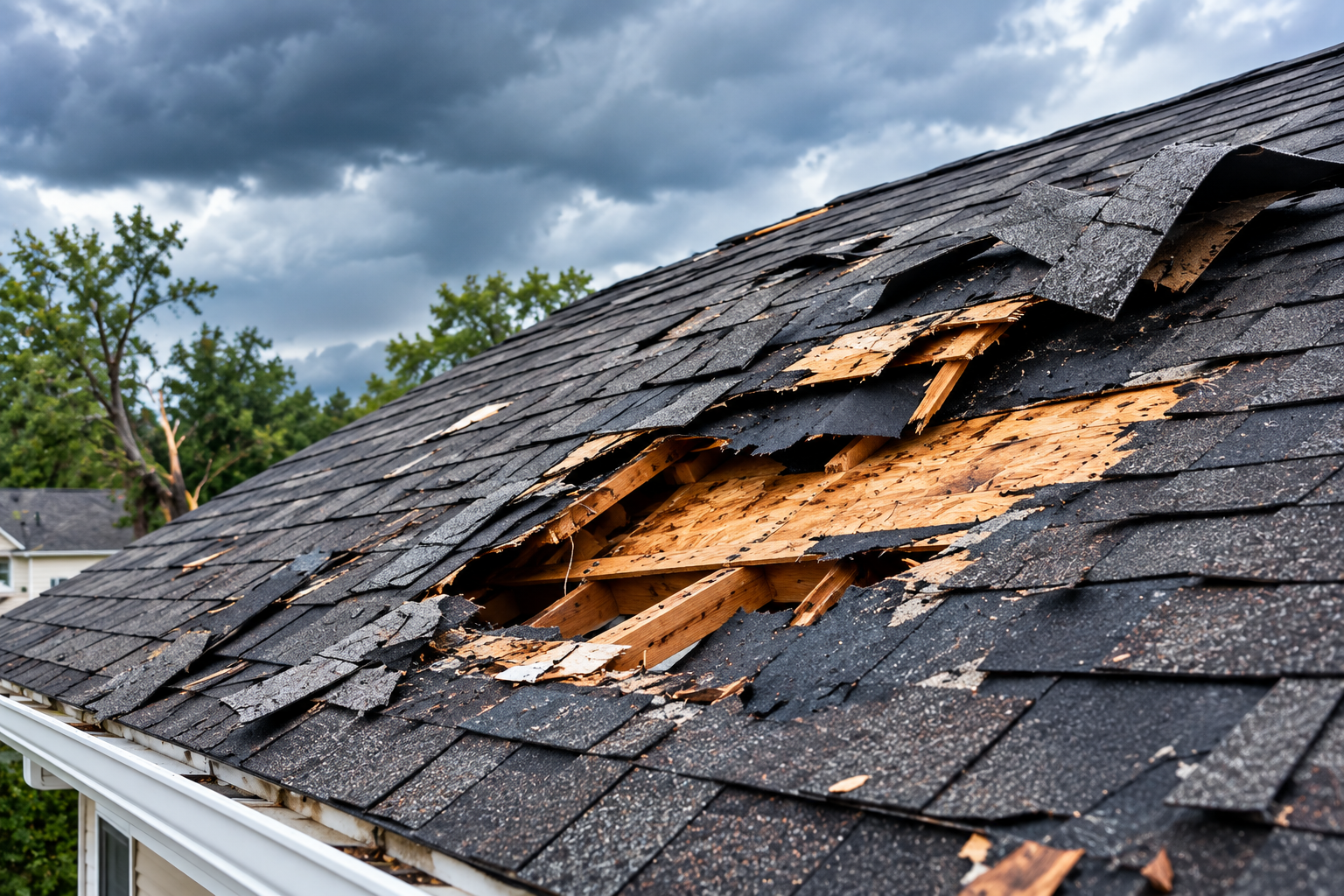
    A spring storm moves across Cobb County on a Thursday afternoon. Twenty minutes of hail rattles through the Marietta Square, Whitlock Avenue, and the subdivisions off Powder Springs Road. By dinnertime, hundreds of homeowners are on their phones searching “roof inspection Marietta” and “hail damage roofer near me.”

    Google shows them three roofing companies in the Map pack, and most of those homeowners call one of the three. If your company isn’t there, it doesn’t matter how good your crews are or how long you’ve served Cobb County. For that storm, you don’t exist.

    That’s what local SEO for roofing companies in Marietta is about: making sure your company is one of the first names Marietta homeowners see when they need a roofer. This guide explains how it works in this market, what to build first, and how to get ahead of storm season instead of chasing it.

    Why Marietta Is Its Own Roofing Market

    Many roofers treat “metro Atlanta” as one big service area. Google doesn’t. It weighs distance from the searcher heavily, so the results a homeowner sees in Marietta can be completely different from what someone sees in Decatur or Buckhead. Ranking well near your shop in Smyrna or Kennesaw doesn’t guarantee you’ll show up for a homeowner near Marietta Square.

    Marietta also has a housing mix that shapes the kind of roofing work available:

    • Historic homes near the Square and along Church Street and Kennesaw Avenue often need careful repair work, specialty materials, and a contractor homeowners trust with an older house.
    • Established subdivisions from the 1980s and 1990s, especially toward East Cobb, have roofs reaching the end of their lifespan. That creates steady retail replacement work between storms.
    • Newer neighborhoods and townhome communities bring HOA requirements and homeowners who are researching roofers online for the first time.

    Each of these homeowners searches differently, and your website and Google Business Profile need to speak to all of them. A single “Areas We Serve” page with Marietta in a list of twenty cities won’t do it.

    Storm Season Decides Your Year

    Weather drives most roofing demand in Cobb County. The National Weather Service office in Peachtree City tracks severe weather across north and central Georgia, where damaging winds, large hail, and tornadoes show up multiple times a year. Spring, roughly March through May, brings the heaviest hail. Summer brings straight-line winds and falling trees. Tropical storm remnants in late summer and fall add more.

    The catch is timing. Rankings can’t be built in the 48 hours after a hailstorm. By the time hail is falling on Marietta, Google has already decided which roofers it trusts in those ZIP codes: 30060, 30062, 30064, 30066, 30067, 30068, and 30008. That decision was made over the previous several months.

    The roofers who stay booked every April did their local SEO work in November. We cover the full pre-season checklist in Emergency Roof Repair Marketing: What Atlanta Roofers Must Set Up Before Storm Season.

    How Google Decides Which Marietta Roofers to Show

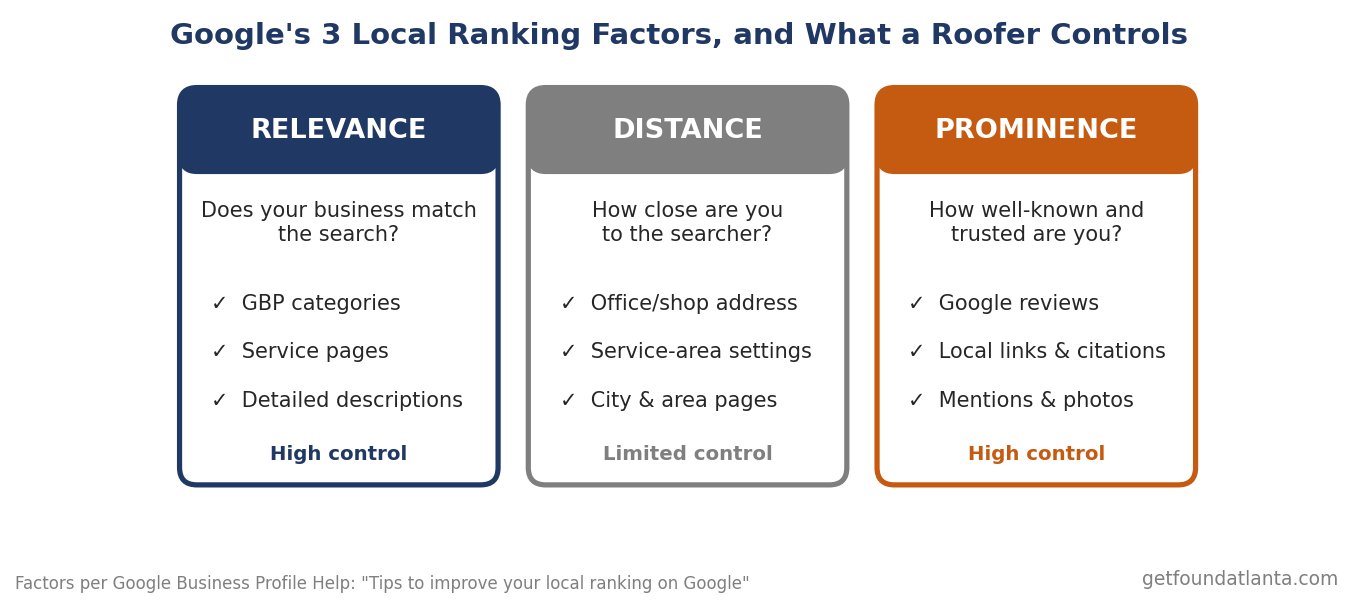
    Google ranks local businesses mainly on three factors: relevance, distance, and prominence.

    • Relevance is how well your business matches the search. Complete service listings and dedicated service pages tell Google exactly what you do.
    • Distance is how close you are to the person searching. You can’t move your office, but you can set up your service area correctly and build content specific to Marietta.
    • Prominence is how well-known and trusted your business is. Reviews, links, and consistent business listings all feed into it.

    Two of those three factors are within your control. Most Marietta roofers who struggle in search aren’t losing on distance. They’re losing because a competitor has a more complete profile, more recent reviews, and better pages. For a deeper look at how these factors work, read our guide to local SEO for roofing companies in Atlanta.

    The Five Things That Move Marietta Rankings

    1. A Fully Built Google Business Profile

    Your Google Business Profile is what appears in the Map pack, and it’s where most urgent roofing calls begin. A storm-ready profile for a Marietta roofer should include:

    • “Roofing contractor” as the primary category, with relevant secondary categories
    • Every service listed on its own: roof replacement, roof repair, hail damage inspection, storm damage repair, emergency tarping, and gutter repair
    • Accurate hours, including emergency availability if you offer it
    • Service areas set to where you can actually respond quickly
    • Fresh photos from real Marietta jobs, added regularly
    • Posts ready to publish the moment severe weather is forecast

    Most roofing profiles are missing more than half of these, which makes this the fastest and cheapest ranking win available.

    2. A Real Marietta Roofing Page

    Google ranks pages, not websites. A homeowner searching “roof replacement Marietta GA” is best matched with a page about roofing in Marietta, one that mentions local neighborhoods, the storms that hit the area, and photos of jobs you completed there. Copying your Smyrna page and swapping in the city name doesn’t work, and Google can tell.

    Build separate pages for your core services too: emergency repair, storm and hail damage, insurance claim help, and full replacements. Then connect them to the Marietta page so Google understands you do all of those things in this city. You can see how we structure local content on our Marietta page.

    3. A Steady Flow of Recent Reviews

    Reviews help your ranking and are often the deciding factor when a homeowner compares three roofers side by side. Recency matters as much as volume. A roofer with 30 reviews from this year can outrank one with 200 from four years ago.

    Set up a system that texts every customer a review link as soon as the crew packs up. Encourage specific reviews. “They replaced our hail-damaged roof off Roswell Road and handled the insurance claim” does more for your Marietta rankings than “Great job.”

    4. Consistent Business Information Everywhere

    Your business name, address, and phone number should match exactly across your website, Google, Facebook, Yelp, the BBB, and roofing directories. Inconsistencies quietly confuse Google, and they hurt even more in AI search. When homeowners ask ChatGPT or Google’s AI Overviews “who’s a good roofer in Marietta,” those tools pull heavily from directory listings and reviews. Mismatched data can get you skipped. Our AI SEO service is built to fix exactly that.

    5. A Website That Turns Searches Into Calls

    Ranking only matters if the visit turns into a call. Most Marietta homeowners search on a phone, often while standing in the driveway looking up at the damage. Your site needs to load in a couple of seconds, put a tap-to-call button at the top of every screen, show proof of insurance and local history, and offer a short quote form with photo upload.

    If your current site falls short, our website services and website redesign use a template built specifically for roofing companies.

    Beating Storm Chasers in Cobb County

    Within a day or two of a major hail event in Marietta, out-of-state crews arrive and start knocking doors. Trying to out-knock them is a losing fight. They have more people and nothing to lose when they leave in August.

    The fight you win is search. A storm chaser has no Google Business Profile in Cobb County, no local review history, and no Marietta content. When a homeowner skips the knock at the door and searches instead, the storm chaser is invisible. You shouldn’t be.

    Say it plainly on your website, in your profile description, and in review responses: locally owned, serving Marietta, and here long after the storm. We cover more ways to capture this work in How Do I Get More Emergency Storm-Damage Roofing Jobs?

    Don’t Forget the Insurance Researcher

    Not every Marietta homeowner calls right away. Many spend weeks researching the claims process first, searching things like “does insurance cover hail damage roof Georgia” and “how does a roof deductible work.” Very few local roofers write honest, plain-language content for these searches.

    The company that explains deductibles, adjusters, and the claims process clearly becomes the trusted voice before the homeowner ever picks up the phone. We break down all four types of roofing searchers in How Metro Atlanta Homeowners Actually Search for a Roofing Company.

    What About Paid Ads?

    Local SEO is the long-term foundation. Google Business Profile improvements often show movement within 30 to 90 days, while competitive organic rankings usually take four to nine months. If you need calls sooner, Google Ads and Local Services Ads can fill the gap. After a hailstorm, you can target only the Marietta ZIP codes that got hit. Most roofers should run both for a while, then scale back paid spend as rankings take over.

    Expand From Marietta Outward

    Once you’re established in Marietta, the same approach works for nearby cities. Many Cobb County roofers build a cluster that includes Smyrna, Kennesaw, and East Cobb, then grow into Sandy Springs and north Fulton. Building real strength in a few areas beats spreading thin across the whole metro.


    Ready to Be the Roofer Marietta Calls First?

    Get Found Atlanta works only with roofing and tree service companies across metro Atlanta. You never have to explain storm season, insurance claims, or how your business runs, because we already know. We’ll build your Google Business Profile, Marietta service pages, review system, and AI search visibility so homeowners find your company first, storm after storm.

    Here’s how to get started:

    • Book your free consultation and we’ll show you where your company ranks in Marietta today, who is beating you, and what it will take to change that before the next storm season.
    • Prefer to see what’s broken first? Request a free website audit with custom recommendations sent to your inbox.
    • Call (704) 996-6472 to talk with us directly.

    Learn more about our Local SEO services and Roofing SEO in Atlanta, or read what clients say on our reviews page.

    Get found. Get calls. Grow your Marietta roofing business.

    Free Website Audit

    Questions about an existing site? We provide a free analysis sent via email with customized recommendations.
    • This field is for validation purposes and should be left unchanged.

  • Why Marietta Tree Companies Lose Jobs Without a Professional Website

    Marietta Tree Companies

    It’s 9:40 on a Tuesday night in Marietta. A homeowner off Roswell Road hears a crack, walks out with a flashlight, and finds a water oak leaning hard toward the corner of the roof. She doesn’t call her neighbor. She doesn’t ask on Nextdoor. She types “emergency tree removal Marietta” into her phone and starts tapping.

    Within about four minutes, she has called someone.

    That’s the whole contest. Not who has the best climbers, the newest chipper or the fairest price. Whoever she could find, trust and reach in those four minutes gets a look at that oak. Everyone else finds out later, if at all.

    This is how experienced tree companies in Cobb County lose work to outfits with half the skill. The crews are fine. The equipment is fine. The problem happens before anyone ever sees the crew.

    Homeowners Decide Fast, and They Decide on Answers

    Tree work is rarely a leisurely purchase. It’s a dead pine near a bedroom, limbs on a Georgia Power line, storm debris across a driveway in East Cobb, or a stump that has to go before the patio pour on Saturday.

    In that state of mind, a homeowner is scanning for answers to seven questions:

    • Do you work in Marietta, or my part of Cobb County?
    • Do you do the specific thing I need?
    • Can I call you right now?
    • Are you insured?
    • Have you done work like mine?
    • Do other people around here trust you?
    • How do I get a price?

    Answer those in the first screen and you get the call. Bury them, and she’s already on the next result. Your website’s job is not to impress her. It’s to remove every reason to keep scrolling.

    We break down that search behavior in detail in How Metro Atlanta Homeowners Actually Search for a Roofing Company. The pattern is nearly identical for tree work, just with more urgency and less patience.

    A Facebook Page Is Not a Website

    Plenty of good tree companies around Marietta run on Facebook alone. It’s free, it’s familiar, and posting a shot of a 90-foot pine coming down in sections gets real engagement.

    Keep doing that. Just understand what it can’t do.

    A homeowner who finds you on Google and lands on a Facebook page has to work out, from scattered posts and comments, whether you’re still in business, whether you’re insured, whether you handle her service, and how fast you answer. Some homeowners aren’t on Facebook at all. Others hit the login wall and bounce.

    A website puts the answers in a fixed place you control: phone number on every screen, service area stated plainly, services listed, proof of work, a form that reaches you. Then your Facebook photos become supporting evidence instead of the whole case.

    Your Customer Is Standing in the Yard Holding a Phone

    Almost nobody researches tree removal at a desk. They’re in the driveway, in the backyard, or in a car looking at a photo they just took of a split trunk.

    So the only version of your website that matters is the one on a five-inch screen in bright sunlight with one bar of service. If it loads slowly, hides the phone number behind a menu, or opens a ten-field form, you have handed the job to whoever loaded faster.

    What a mobile-first tree service site needs:

    • A Call Now button pinned where a thumb naturally lands
    • A short estimate form: name, phone, address, what happened
    • A photo upload field, because a picture of the tree saves you a trip
    • Your service area visible without scrolling
    • Compressed images and a fast host
    • A clear line on whether you take emergency calls

    We build contractor websites around exactly these elements, and if your current site is beyond patching, a website redesign starts from the same principles. The goal isn’t a prettier site. It’s fewer reasons to hang up.

    One “Services” Page Is Costing You Jobs

    Most tree company websites have a single Services page that mentions removal, trimming, stump grinding, storm cleanup and lot clearing in about four paragraphs.

    That page is asking one piece of content to win five different searches, and it usually wins none of them.

    “Emergency tree removal Marietta GA” and “stump grinding near Marietta” come from two different people with two different problems, two different budgets and two different levels of panic. Google treats them as separate questions. Your site should too.

    A tree company in Marietta should have real pages for:

    • Tree removal
    • Emergency tree removal
    • Storm damage cleanup
    • Tree trimming and pruning
    • Stump grinding
    • Land and lot clearing
    • Brush and debris hauling
    • Commercial and HOA tree work
    • Crane-assisted removal, if you run one

    Then location pages for the places your crews actually go: Marietta first, then Kennesaw, Acworth, Powder Springs, Austell, Smyrna, Sandy Springs.

    Note the word actually. Spinning up forty near-identical city pages for towns you’ve never worked in is the fastest way to build a site full of thin content that helps nobody. Our local SEO work builds pages for the real service areas, with real job photos and details specific to each one. See what we do in Marietta.

    Trust Is the Whole Decision

    A homeowner hiring a tree company is inviting strangers with chainsaws to work twenty feet above her roofline, near her fence, her cars and a power drop. She is not price shopping. She is risk shopping.

    Every element on your site either lowers that risk or leaves it sitting there:

    • Before-and-after photos of real Marietta jobs, not stock imagery
    • A gallery that shows the hard removals, the tight drops, the cleanup
    • Recent reviews with names and neighborhoods
    • Proof of insurance, stated plainly
    • Years in business and who owns the company
    • Your equipment and what it lets you handle
    • A real phone number, not just a form

    None of these wins the job alone. Together they answer the only question she’s really asking: can I trust these people with my house?

    A logo, one stock photo of a chainsaw and a contact form do not answer it. Your site should look as professional as your crew looks when the truck pulls up.

    Google Maps and Your Website Are One System

    Most Marietta tree calls start in the map results: “tree removal near me,” “emergency tree service Marietta,” “stump grinding Marietta GA,” “tree down on house.”

    Google decides those results largely on relevance, distance and prominence. Your Google Business Profile drives the first two. Your website, reviews and consistency across the web feed the third.

    That’s why the two can’t be worked on separately. A profile that gets clicks and sends people to a broken 2016 website loses the job at the last step. A beautiful site nobody finds in Maps never gets the chance.

    What we align in our local SEO work: categories and services on your profile, service areas that match where crews actually go, hours that reflect whether you answer at 10pm, photos from real jobs, identical name, phone and address everywhere they appear online, and website pages that match the services your profile claims.

    For more on turning that visibility into booked work, read How to Get More Tree Service Jobs Near Atlanta, GA.

    Storm Season Rewards Whoever Was Already Ready

    Metro Atlanta gets its worst tree damage in bursts. A spring line of storms crosses Cobb County, or the remnants of a Gulf system stall over north Georgia in September, and suddenly every phone in the tree business rings at once.

    You can’t build visibility during that window. Rankings don’t move in 48 hours, and a new page published the morning after the storm won’t rank in time.

    What you can do is be ready before it:

    • An emergency tree service page published and indexed well in advance
    • Storm damage language already on the site, so it matches what people type
    • Profile hours that reflect after-hours availability, if you offer it
    • A photo-upload form so you can triage jobs without driving to each one
    • Recent reviews and fresh job photos already in place

    Don’t promise a two-hour arrival you can’t hit. Say plainly what you do, where you go and how to reach you. Clear beats aggressive, and it keeps your reviews clean after the storm passes. This is the same pre-season logic we lay out for roofers in Emergency Roof Repair Marketing.

    Homeowners Are Asking AI Now, Too

    A growing share of Marietta homeowners open ChatGPT or read Google’s AI Overviews before they ever hit a map result. They ask things like “who removes dangerous trees in Cobb County” or “what do I do if a tree falls on my house in Georgia.”

    Those answers get assembled from what the web already says about local businesses: consistent listings, reviews, clearly written pages that answer real questions. Ranking well on Google helps, but it doesn’t automatically carry over, and a company with thin or contradictory information online is hard for any system to recommend with confidence.

    There’s no trick here. Our AI SEO work is mostly the unglamorous foundation: accurate data everywhere, real reviews, structured pages, and content written to answer the questions homeowners actually ask. That work helps people, Google and AI tools at the same time.

    The Ten-Point Check for a Marietta Tree Company Website

    Open your site on your phone, outside, and go down this list honestly.

    1. Services are obvious. Within one screen, a visitor knows whether you do removal, trimming, stumps, storm work or clearing.
    2. Service area is stated. Marietta by name, plus the surrounding towns you truly cover.
    3. Contact is everywhere. Tap-to-call at the top of every page and a short form, not one buried Contact link.
    4. It loads fast on cellular. Compressed photos, no bloated sliders.
    5. The work is real. Your jobs, your trucks, your crews, your neighborhoods.
    6. Trust is visible. Reviews, insurance, years in business, owner’s name.
    7. Emergency status is clear. If you take after-hours calls, say so. If not, don’t imply it.
    8. Service and city pages exist. Not one Services page doing all the work.
    9. Everything matches Google. Same name, phone, hours and services as your Business Profile.
    10. The next step is unmistakable. Call, request an estimate, or send photos.

    If you’re missing four or more of these, that’s not a small design problem. That’s a steady leak of calls your crews never hear about. A free site audit will show you which ones are costing the most.

    What Working With Get Found Atlanta Looks Like

    We work with roofing and tree service companies in Metro Atlanta. That’s it. You never have to explain crane days, why the phone dies in February, or what a takedown over a pool actually involves. More about us.

    What that focus gets you:

    • A website built to convert, not to win awards. Tap-to-call, short forms, photo upload, fast on cellular. See website services, and ongoing management once it’s live so it doesn’t go stale.
    • Google Maps visibility where your crews actually run. Profile, categories, service areas, reviews and city pages handled together. See local SEO.
    • A foundation AI tools can read. Consistent data and clear answers, covered in AI SEO.
    • No channels you don’t need. We don’t run your ads or post to your social accounts. We make sure the traffic they send lands somewhere that produces calls. See marketing services.
    • Everything stays yours. Your domain, site, Google profile and accounts are in your name. Month to month after setup.

    Start With a Free Visibility Review

    We’ll check where your tree company shows up across Marietta and the surrounding Cobb County areas, which competitors are outranking you and why, what’s missing from your Google Business Profile, and how your website performs on a phone. You get the findings whether you hire us or not.

    Request your free visibility review, or call (704) 996-6472.

    The Bottom Line

    Marietta tree companies rarely lose jobs because of the work. They lose them at 9:40 on a Tuesday night, when a homeowner with a leaning oak finds somebody easier to discover, easier to trust and easier to call.

    Your crews already earn the reputation. A professional website makes sure it’s visible in the four minutes that decide who gets the job.

    Free Website Audit

    Questions about an existing site? We provide a free analysis sent via email with customized recommendations.
    • This field is for validation purposes and should be left unchanged.

  • Local SEO for Roofing Companies in Atlanta

    Severe Weather Breakdown

    A hailstorm rolls across Cobb County on a Tuesday afternoon. By Wednesday morning, hundreds of homeowners from Marietta to Smyrna are on their phones typing “roof repair near me” and “roofer for hail damage.” Within seconds, Google shows them three roofing companies in the Map pack. Most of those homeowners will call one of those three. They will never scroll far enough to find you.

    That is the reality of roofing in Atlanta today. The quality of your work still matters, but it no longer decides who gets the first call. Visibility does. And the most reliable, cost-effective way to earn that visibility is local SEO for roofing companies: the process of making your business show up when nearby homeowners search for the services you offer.

    This guide explains exactly how local SEO works for roofers, which roofing SEO services actually move the needle, what separates the best local SEO from the rest, and how to win searches across the Atlanta metro, from the Tri-Cities to the northern suburbs. It is written for roofing company owners, not marketers, so you will find plain language, real examples, and clear next steps.

    Key Takeaways

    ✓  Google ranks local businesses on three factors: relevance, distance, and prominence. You can directly improve two of them.

    ✓  Your Google Business Profile, reviews, and service pages drive most of your Map pack visibility.

    ✓  “Near me” searches reward roofers who set up service areas correctly and build pages for each city they serve.

    ✓  Atlanta storm season peaks March through May, so the best time to build rankings is before the hail arrives.

    ✓  Unlike paid ads, local SEO keeps producing calls after the work is done.

    Local SEO for Roofing Companies: What It Is and Why It Wins Jobs

    Local SEO is different from regular SEO. Regular SEO tries to rank a website nationally for broad topics. Local SEO focuses on one goal: showing up when someone in your service area searches for what you do. For a roofer, that means searches like “roof replacement Atlanta,” “emergency roof tarp Decatur,” or simply “roofers near me.”

    Those searches trigger two kinds of results. The first is the Google Map pack, the box of three businesses shown with a map near the top of the page. The second is the organic results, the regular blue links below it. Local SEO for roofing companies works on both at the same time.

    How Google Decides Which Roofers to Show

    Google has publicly explained how it ranks local businesses. According to its Business Profile help guide, local results are based mainly on three factors: relevance, distance, and prominence.

    Local Ranking Factors

    Figure 1: Google’s three local ranking factors and the parts a roofing company can control.

    • Relevance is how well your business matches the search. Complete, detailed business information helps Google understand what you do. For a roofer, that means the right categories, detailed service descriptions, and a dedicated page for each service.
    • Distance is how far your business is from the person searching. You cannot move your shop, but you can set up your service area correctly and build content for the cities you cover.
    • Prominence is how well-known your business is. Google says this is based partly on how many websites link to you and how many reviews you have, and that more reviews and positive ratings can help your local ranking.

    Here is the key insight: two of the three factors are within your control. Most roofing companies that struggle in local search are not losing because of distance. They are losing because a competitor has a more complete profile, more reviews, and better service pages.

    Why Local SEO Beats Renting Visibility

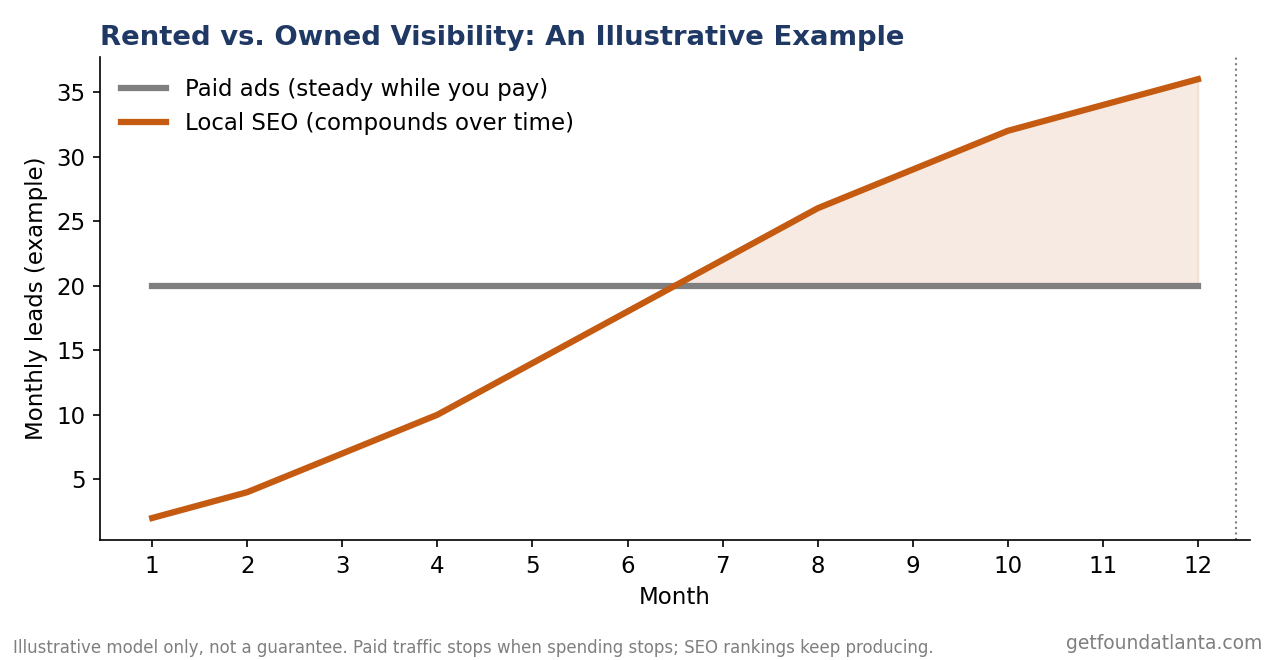
    Many roofers try to buy their way to the top with paid ads or lead-generation platforms. Those can work in the short term, but the traffic stops the moment you stop paying. Local SEO works differently. Rankings, reviews, and a strong profile keep bringing in calls month after month. We break down the real numbers in our honest guide to PPC for Atlanta contractors.

    Rented vs. Owned

    Figure 2: Illustrative example of rented visibility (ads) vs. owned visibility (local SEO). Not a guarantee of results.

    Roofing SEO Services

    “Roofing SEO services” can mean almost anything, and that is part of the problem. Some providers do little more than send a monthly report. Real roofing SEO services cover every signal that affects whether a homeowner finds you and calls you. Here is what a complete program should include.

    ServiceWhat It DoesWhy It Matters for Roofers
    Google Business Profile optimizationSets correct categories, services, hours, photos, and descriptionsDrives Map pack visibility, where most urgent roofing calls start
    Service pagesOne page each for replacement, repair, storm damage, inspections, guttersTells Google exactly which searches you are relevant for
    City and area pagesUnique pages for each city you serve, with local job photosHelps you rank beyond the area around your shop
    Review generationA simple system for asking every happy customer for a reviewBuilds prominence and homeowner trust at the same time
    Citation cleanupMakes your name, address, and phone identical across the webInconsistent info confuses Google and AI tools
    Technical website fixesSpeed, mobile usability, tap-to-call, schema markupA slow site loses homeowners in seconds
    AI search optimizationStructures content so ChatGPT, Gemini, and AI Overviews can cite youMore homeowners now ask AI who to call

    Google Business Profile Optimization

    Your Google Business Profile is the single most important asset in local SEO for roofing companies. It is what appears in the Map pack and on Google Maps. A fully optimized roofing profile includes:

    • The most accurate primary category (usually “Roofing contractor”) plus relevant secondary categories.
    • Every service you offer listed individually, such as roof replacement, roof repair, storm damage repair, and roof inspections.
    • Accurate hours, including emergency availability if you offer storm response.
    • Fresh photos from real jobs, uploaded regularly, not stock images.
    • A description that explains what you do and where you work in plain language.

    Learn more about how we handle this on our Local SEO services page.

    Service Pages and City Pages

    One “Services” page listing everything you do is not enough. Google ranks pages, not websites. A homeowner searching “metal roof installation Sandy Springs” is best matched with a page about metal roofs that mentions Sandy Springs and shows work you did there. Building a page for every core service and every major city you serve is one of the most powerful moves a roofer can make. You can see an example of a city-focused page on our East Point page.

    Reviews: Your Most Visible Trust Signal

    Reviews do double duty. They help your ranking, and they are often the deciding factor when a homeowner compares three roofers side by side. The roofers who win are rarely the ones with a burst of reviews in one month. They are the ones who ask every satisfied customer, every time, with a simple text or email link after the job is finished. Responding to every review, good or bad, shows homeowners and Google that you are active and professional.

    A Website That Turns Visitors Into Calls

    Ranking only matters if the visit turns into a call. Your website needs a visible tap-to-call button on every phone screen, a short estimate form, clear service areas, real project photos, and fast load times. If your current site falls short, our website services, including website redesign and ongoing website management, are built specifically to convert local traffic.

    AI Search Visibility

    Homeowners increasingly ask ChatGPT, Gemini, or Google’s AI Overviews questions like “Who is a reliable roofer in Decatur?” These tools build their answers from reviews, directory listings, consistent business information, and clearly written content. Ranking on Google does not automatically carry over. Learn how we prepare roofers for this shift on our AI SEO page.

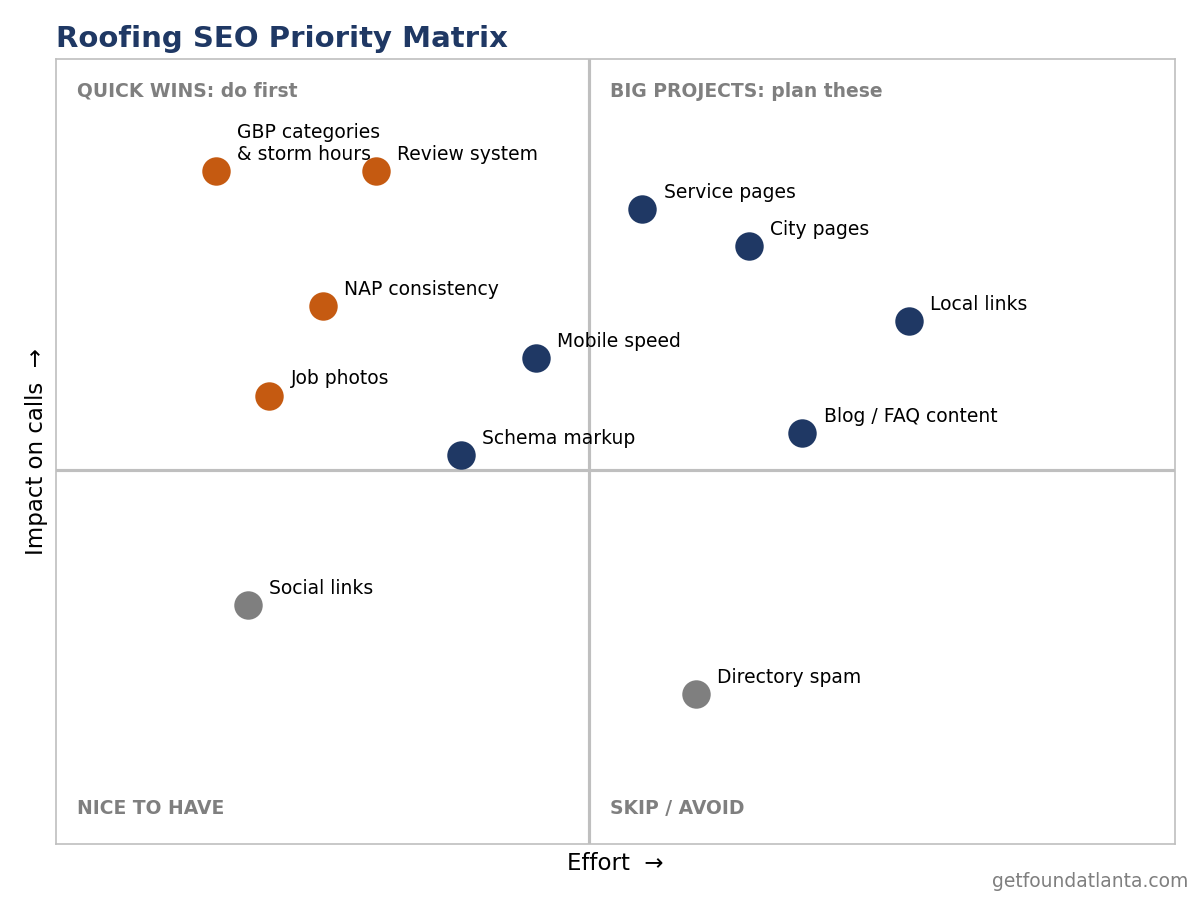
    Where to Start: A Priority Matrix

    If you are doing this yourself or working with a limited budget, focus on the tasks with the highest impact for the least effort first.

    Roofing SEO Priority Matrix

    Figure 3: Roofing SEO priority matrix. Start in the top-left quadrant.

    Local SEO for Roofing Companies Near Me

    “Near me” searches are the heartbeat of roofing leads. When a homeowner types “roofers near me” or “roof leak repair near me,” they are usually ready to call now. Google answers those searches almost entirely based on the searcher’s location, which makes them some of the most valuable and competitive searches in the industry.

    You do not need to stuff the words “near me” onto your website. Google already knows where the searcher is. What you need is to give Google every reason to believe you serve that area and do that job well.

    How to Win “Roofer Near Me” Searches

    1. Set your service area correctly. If you visit customers rather than having them come to you, configure your Google Business Profile as a service-area business and list the cities and zip codes you actually cover.
    2. Build location pages for each core city. A page for roofing in Marietta, another for Smyrna, another for College Park. Each page should include unique content, local job photos, and nearby landmarks or neighborhoods, not the same text with the city name swapped.
    3. Earn reviews that mention the location and service. A review that says “They replaced our roof in Decatur after the hailstorm” helps more than “Great job.” You cannot script reviews, but you can ask customers to mention what you did and where.
    4. Keep your name, address, and phone number identical everywhere. Your website, Google profile, Facebook, Yelp, the BBB, and industry directories should all match exactly.
    5. Post real job photos with location context. Before-and-after photos from local jobs show Google and homeowners that you work in the area right now.
    6. Make your site fast and mobile-friendly. Most “near me” searches happen on phones, often right after a storm, often from homeowners on cellular data.

    Social media can support this too. Linking to real local job posts from your website shows activity and builds trust. See how on our social media page.

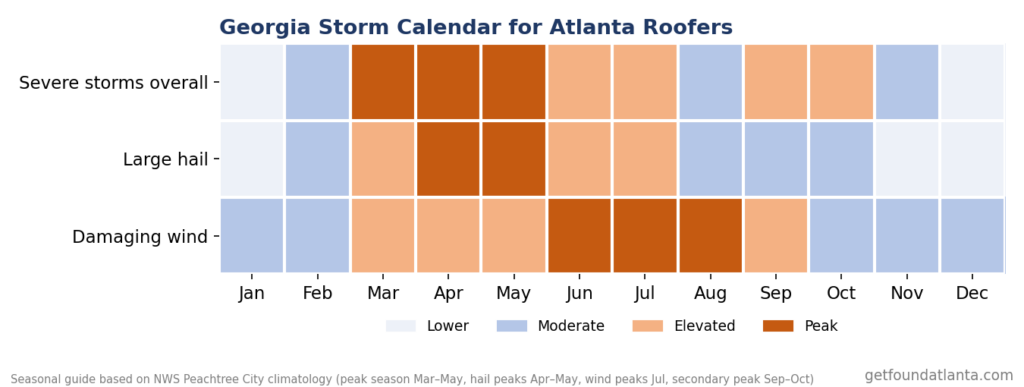
    The Storm Search Opportunity

    Storm Calander

    After severe weather, searches like “emergency roof repair near me” and “roof tarp service” spike overnight. Roofers with emergency hours listed on their profile, a dedicated storm damage page, and a clear “call now” button on mobile are positioned to capture that surge. Roofers without them are invisible until the rush is over.

    Best Local SEO for Roofing Companies

    Local SEO Opportunity

    Every provider claims to offer the best local SEO for roofing companies. The truth is that “best” is not about fancy dashboards or big promises. It is about whether the work puts roofing jobs on your schedule. Here is how to tell the difference.

    What the Best Local SEO Looks Like

    What to ExpectRed Flags to Avoid
    Reporting tied to calls, form leads, and booked jobsReports that only show traffic and “impressions”
    Realistic timelines with honest rangesGuaranteed #1 rankings or page-one results in 30 days
    You own your website, profile, and accountsProvider keeps ownership of your site or listing
    A page for each service and each city you serveOne generic page listing twenty towns
    Real job photos and local contentStock photos and copy-and-paste city pages
    Month-to-month flexibility after setupLong contracts that lock you in
    Focus on roofing and home servicesA one-size-fits-all plan for every industry

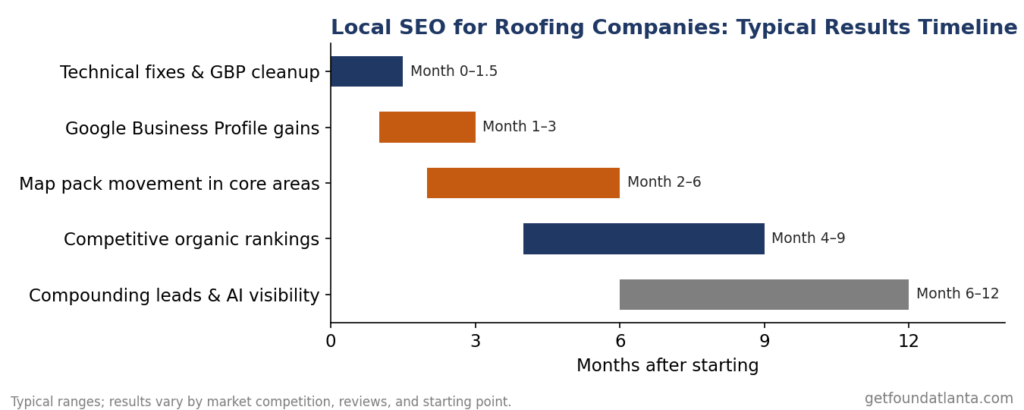
    Realistic Timelines Matter

    Local SEO is not instant, and anyone who says otherwise is either misleading you or using risky tactics that can get your profile suspended. In our experience, Google Business Profile improvements typically show meaningful results in 30 to 90 days, while competitive organic rankings generally take four to nine months. The payoff is that results compound over time instead of disappearing when a budget runs out.

    Figure 4: Typical local SEO timeline for roofing companies. Results vary by market and starting point.

    Why Specialization Wins

    Roofing has its own seasons, its own search patterns, and its own buying process. Insurance claims, storm surges, and the difference between a $400 repair and a $15,000 replacement all shape how you should be marketed. A provider who understands your trade will build a strategy around those realities instead of treating you like a dentist or a restaurant. That is why Get Found Atlanta works only with roofing and tree service companies. Learn more about our company and read what clients say on our reviews page.

    Questions to Ask Before You Hire Anyone

    • How will you measure success in calls and booked jobs, not just rankings?
    • Do I own my website, Google Business Profile, and all accounts?
    • Will you build separate pages for each service and city?
    • How do you help me get more reviews?
    • What results should I realistically expect in 90 days, 6 months, and 12 months?
    • Is there a long-term contract?

    SEO for Roofing Companies Near Atlanta, GA

    Atlanta is one of the most competitive roofing markets in the Southeast, and it is not one market. It is dozens. Ranking in Buckhead does nothing for you in Douglasville. The competition in Alpharetta looks nothing like Stockbridge. Effective SEO for roofing companies near Atlanta, GA starts by choosing the specific areas where your best jobs are and building visibility there first.

    Atlanta’s Storm Seasons Drive Roofing Demand

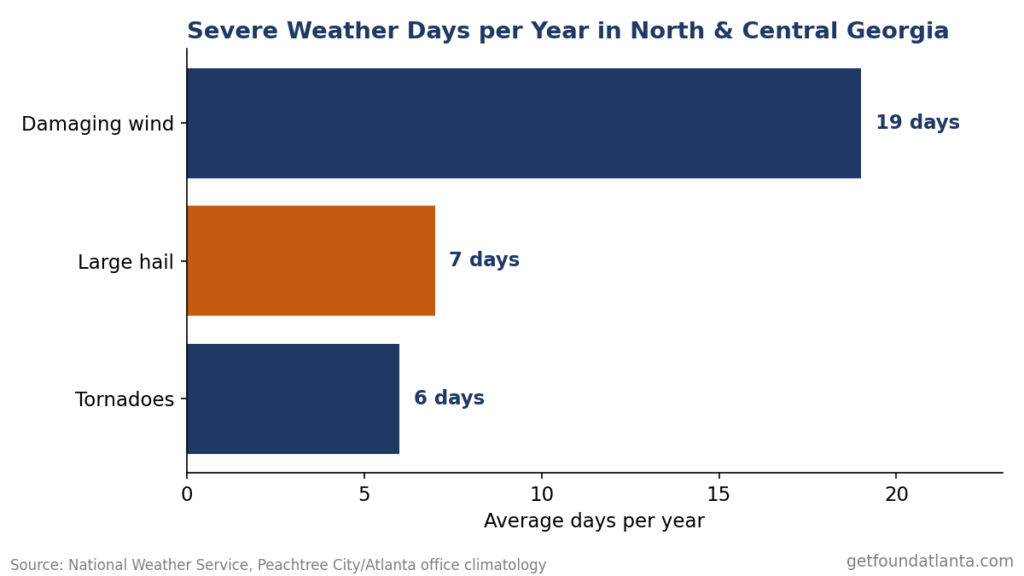
    Weather is the biggest driver of roofing searches in metro Atlanta. According to the National Weather Service Peachtree City office, north and central Georgia sees damaging thunderstorm winds on about 19 days a year, large hail on about 7 days, and tornadoes on about 6 days.

    Free Website Audit

    Questions about an existing site? We provide a free analysis sent via email with customized recommendations.
    • This field is for validation purposes and should be left unchanged.

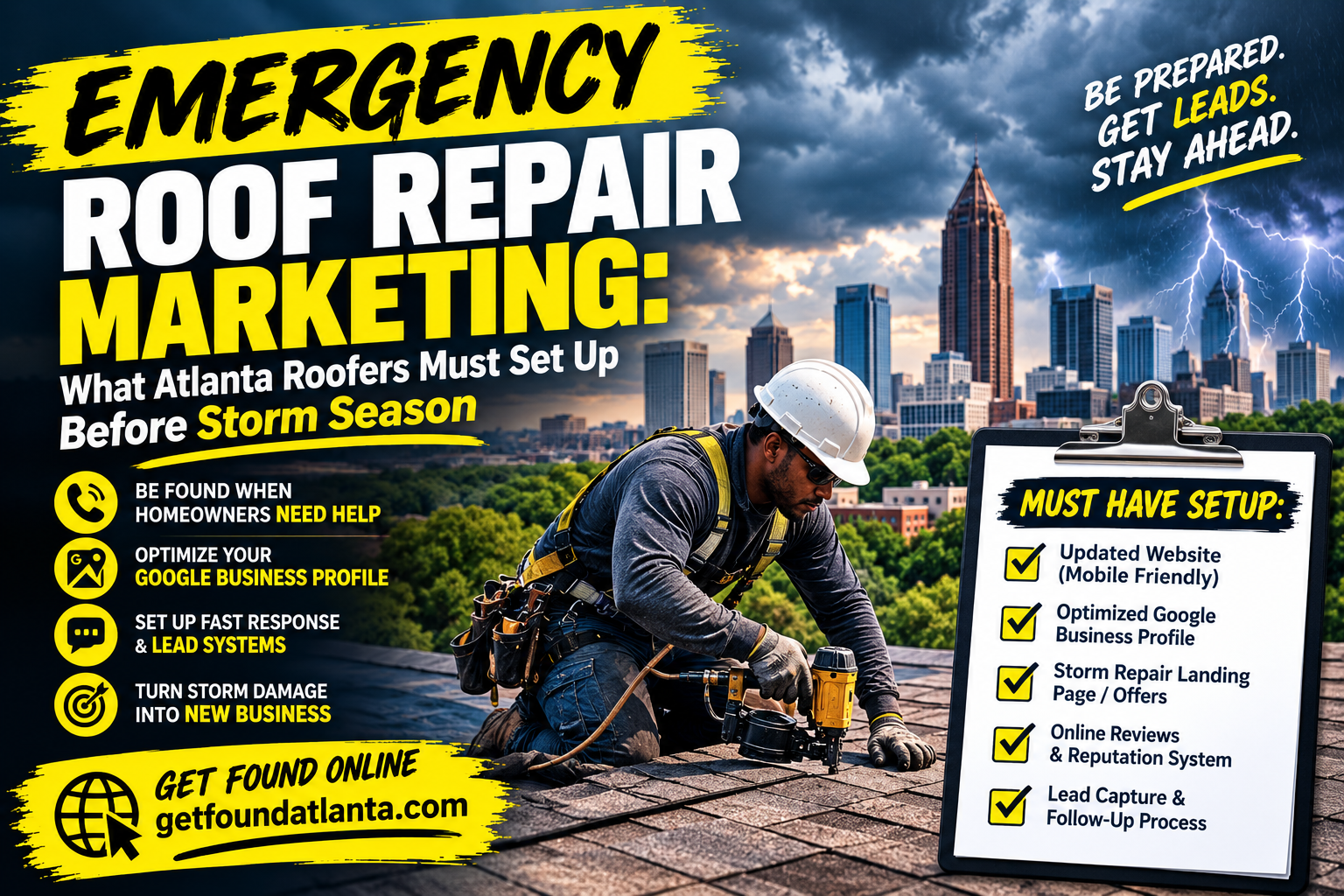
  • Emergency Roof Repair Marketing: What Atlanta Roofers Must Set Up Before Storm Season

    Emergency Roof Repair Marketing

    Every spring, the same thing happens across metro Atlanta. A line of severe storms crosses from Alabama, hail rattles through Cobb, Cherokee, and north Fulton for ten or fifteen minutes, and by the next morning thousands of homeowners are searching for help. Some roofing companies are booked for six weeks. Others watch the whole surge pass them by.

    The difference almost never shows up on the roof. It shows up in what each company set up before the storm arrived.

    Emergency roof repair marketing isn’t something you can build in the 48 hours after a hail event. By then, the homeowners who needed help have already called someone else. Rankings take months to build, Local Services Ads verification takes weeks, and a website can’t be rebuilt overnight. The roofers who win storm season do the work in January and February, so that when the first March supercell rolls through, everything is already live, tested, and ready to catch calls.

    This guide walks through the eight pieces every Atlanta roofing company should have in place before storm season, in the order you should tackle them.

    Why Atlanta Roofers Have to Prepare Early

    Metro Atlanta has more than one storm season. Spring, roughly March through May, brings the most damaging hail, often hitting the northwest suburbs hardest. Summer brings straight-line winds and pop-up thunderstorms that drop mature oaks and pines onto roofs. Late summer and fall bring tropical storm remnants that saturate the ground until trees topple. And every few winters, an ice event adds its own damage.

    Demand from these events is sudden and short. A hailstorm can create weeks of work in a single afternoon, and most homeowners make their hiring decision within a day or two. They aren’t comparing five bids over a month. They’re searching once, on a phone, often while water is dripping into a bucket, and calling one of the first companies that looks trustworthy.

    That’s also the moment out-of-town storm crews arrive and start knocking doors. Your advantage over them is that you’re local, established, and already visible, but only if your marketing is ready before they show up.

    Here’s what to set up.

    1. Build a Dedicated Emergency Roof Repair Landing Page

    Most roofing websites mention emergency service in a single sentence buried on a services page. That costs jobs. When a homeowner searches “emergency roof repair near me” or “24 hour roof repair Atlanta,” Google wants to show a page built specifically for that need, and the homeowner wants a page that tells them in five seconds that help is on the way.

    Your emergency roof repair landing page should do a few things very well.

    Put the phone number first. A large, tap-to-call button at the top of the screen, visible without scrolling on a phone. Repeat it after every section.

    Say what you do in an emergency. Emergency roof tarping, active leak repair, storm damage stabilization, fallen tree damage, and temporary repairs to prevent interior water damage. Be specific, because specific pages rank and convert better than vague ones.

    State your response time and hours honestly. “Same-day emergency tarping across Cobb, Fulton, and DeKalb counties” is far more persuasive than “fast service.” If you answer calls 24/7 during storm events, say so clearly.

    Tell homeowners what to do right now. A short list of safe first steps, like moving valuables away from leaks, placing buckets, taking photos of damage from the ground, and staying off the roof, builds trust immediately and positions you as the expert before you’ve even arrived.

    Show proof. Licensing and insurance information, years serving the Atlanta area, real photos of your crews tarping roofs, and Google reviews that mention emergency work.

    Keep the form short. Name, phone, address, and a photo upload. Nothing more. Someone with water coming through the ceiling won’t fill out twelve fields.

    If your current site can’t support a page like this, or loads slowly on mobile, fix it now. Every site Get Found Atlanta builds uses our own high-converting contractor template, which includes emergency pages and tap-to-call built in. If your site needs a full rebuild, our website redesign service handles it.

    2. Create a Storm-Damage Service Page (Separate From Emergency Repair)

    Emergency repair and storm damage repair sound similar, but they serve different homeowners at different moments.

    The emergency page is for the person with an active leak tonight. The storm-damage page is for the homeowner who heard hail last Tuesday, noticed dented gutters, and wants to know if their roof is damaged and whether insurance will cover it. That homeowner is searching things like “hail damage roof inspection Atlanta,” “storm damage roof repair Marietta,” “wind damage roof repair Sandy Springs,” or “does insurance cover hail damage roof in Georgia.”

    A strong storm-damage service page covers several things.

    What hail and wind damage looks like. Granule loss, bruised or cracked shingles, lifted or missing shingles, dented gutters and vents, and damaged flashing. Photos from real Atlanta jobs make this far more convincing.

    Why a professional inspection matters. Hail damage is often invisible from the ground, and small bruises can turn into leaks months later. Many homeowners don’t realize they have damage until it’s too late to file a claim.

    How the insurance claim process works. This is where most roofing websites fall short and where you can win. Explain in plain language how a typical claim works: documenting damage, filing with the insurance company, meeting the adjuster, understanding the deductible, and what happens if additional damage is found once work begins. Homeowners are confused and anxious about this process, and the company that explains it clearly earns their trust.

    Your inspection offer. A free storm damage roof inspection is one of the most effective calls to action in the industry.

    Then, go one step further by creating city-specific versions for your core service areas, such as storm damage pages for Marietta, Smyrna, Sandy Springs, and Decatur. A page that mentions local neighborhoods, the storms that hit that area, and jobs you’ve completed there will outrank a generic page every time. This is the heart of local SEO for Atlanta roofers.

    Clear, well-structured storm content also helps you show up in AI search. More homeowners are asking ChatGPT and Google’s AI Overviews questions like “what should I do after hail damages my roof,” and those tools pull from pages that answer questions directly. That’s what our AI SEO work is built around.

    Timing matters. New pages take time to get indexed and start ranking, so build these at least two to three months before spring storm season.

    3. Get Your Google Business Profile Storm-Ready

    When a homeowner searches “roofer near me” after a storm, the three businesses in the Google Maps results get most of the calls. Your Google Business Profile determines whether you’re one of them, and storm season is the worst possible time to discover it’s incomplete.

    Before the season starts, walk through your profile and confirm each of these.

    Categories. Your primary category should be correct, with relevant secondary categories added.

    Services. List every service individually, including emergency roof repair, roof leak repair, storm damage repair, hail damage inspection, emergency tarping, roof replacement, and gutter repair. Each one is another chance to match a search.

    Hours. If you offer after-hours emergency response, make your hours reflect it. A profile that shows “Closed” at 9 p.m. tells a homeowner with a leak to call someone else.

    Service areas. List the areas you can actually reach quickly. Spreading across every county in north Georgia dilutes your relevance.

    Business description. Mention emergency and storm damage services, the areas you serve, and that you’re a locally owned Atlanta company. That last point matters when out-of-town crews are flooding the area.

    Posting plan. Prepare storm-response posts in advance so you can publish them within minutes. One goes up when severe weather is forecast, letting homeowners know you’re ready. Another goes up right after the storm passes, confirming crews are dispatching and inspections are available.

    Name, address, and phone consistency. Your business information should match exactly everywhere it appears online. Inconsistencies quietly hurt your rankings and your AI search visibility.

    Google’s own guidance on improving local ranking points to relevance, distance, and prominence as the main factors. A complete, active profile covers the first and strengthens the third.

    4. Prepare Reviews and Photos Before You Need Them

    When a homeowner compares three roofers in the map pack after a storm, reviews and photos make the decision. And both take time to build, which is why they belong on your pre-season checklist.

    Build review momentum now. Reviews are one of the strongest ranking signals for Google Maps and the biggest trust factor for homeowners choosing between unfamiliar companies. Set up a simple system that sends a text with a direct review link to every customer as soon as the job is complete. Winter and early spring, when you’re doing planned replacements and repairs, is the perfect time to build this habit before the storm rush.

    Encourage specific reviews. A review that says “They tarped our roof the same night a tree came down in Smyrna and handled the insurance claim” does more for your rankings and your reputation than “Great job.” You can’t script reviews, but you can ask customers to mention what you did and where.

    Respond to every review. It shows homeowners you’re active and engaged, and it’s another chance to mention your services and service areas naturally.

    Stock your photo library. Organize photos of hail damage close-ups, storm damage, emergency tarping, completed replacements, crews at work, and your trucks with your branding visible. Upload them to your Google Business Profile regularly, and use them on your emergency and storm-damage pages. Real photos from real Atlanta jobs separate you from the companies that just rolled into town.

    Consider short video. A thirty-second clip of your crew tarping a roof in the rain, or walking a homeowner through hail damage, builds trust faster than any paragraph. Those clips can go on your website, your profile, and your social media, and well-optimized videos can also appear in Google and YouTube results for local searches.

    5. Create a Call-Answering Plan for Storm Surges

    This is the part most roofing companies skip, and it’s where the most money is lost.

    You can have the best emergency page in Atlanta, a perfect Google Business Profile, and top-ranked ads. If the phone rings four times and goes to voicemail, the homeowner hangs up and calls the next company. They won’t leave a message and wait. A single missed storm call can be a full roof replacement handed to someone else.

    Storm surges overwhelm normal phone systems. A company that usually handles fifteen calls a day might get eighty the morning after hail. Plan for that now.

    Decide who answers. Assign specific people to phones during storm events, with backups. If you’re a small company, that might mean you, your office manager, and a family member on rotation.

    Set up call forwarding and rollover. Make sure unanswered calls roll to a second and third phone automatically instead of going to voicemail.

    Write a short intake script. Name, phone, address, what happened, whether there’s active water coming in, and whether they’ve contacted their insurance company. A simple script keeps calls fast and lets you prioritize true emergencies first.

    Plan your triage. Active leaks and trees on roofs get same-day response. Inspections for suspected hail damage get scheduled. Knowing the order in advance keeps your crews focused on the highest-value, most urgent work.

    Track every call. Call tracking shows how many calls came in, which ones were missed, and which marketing source produced each one. After storm season, you’ll know exactly where your jobs came from and what’s worth investing in next year.

    6. Set Up Emergency Text-Back or an Answering Service

    Even with a great plan, some calls will slip through, especially after hours or when every line is busy. That’s where a text-back system or answering service becomes your safety net.

    Missed-call text-back sends an automatic text to anyone whose call goes unanswered, something like: “Sorry we missed you. We’re responding to storm calls across metro Atlanta. Reply with your address and what happened, and we’ll get back to you shortly.” Homeowners who might have called the next company now have a reason to wait, and you have their information.

    An answering service puts a live person on the line when your team can’t pick up. During storm season, especially overnight, this can be the difference between capturing a job and losing it. Make sure the service has your intake script and knows how to flag urgent calls.

    Test everything before the season starts. Call your own number after hours. Let it ring out. See what happens. Many roofers discover their voicemail box is full, their forwarding isn’t working, or their text-back was never turned on, and it’s far better to find out in February than during the first hailstorm.

    7. Get Google Ads and Local Services Ads Ready Before You Need Them

    Local SEO and your Google Business Profile are the long-term foundation. Paid ads give you speed when demand spikes. But ads aren’t something you can build from scratch the morning after a storm, especially Local Services Ads.

    Get Local Services Ads verified early. Local Services Ads appear at the very top of many search results with Google’s verification badge, and you pay per lead rather than per click. But the verification process, including background checks and license and insurance review, can take weeks. If you start in March, you may miss the entire spring hail season. Start in the winter.

    Configure your job types and service areas. Make sure emergency and storm-related services are enabled, and that your service areas match where you actually want to work.

    Build Google Ads campaigns ahead of time. Create separate campaigns for emergency roof repair and storm damage, with ad copy focused on fast response, local ownership, and free inspections. Build out your keyword lists, including terms like “emergency roof repair,” “roof leak repair,” “hail damage roof repair,” and “storm damage roof inspection,” along with city variations. Add negative keywords to filter out searches like jobs, DIY, and materials.

    Point ads to the right pages. Emergency ads should go to your emergency landing page. Storm-damage ads should go to your storm-damage page. Sending everything to your homepage wastes money.

    Pause, don’t delete. Once built and tested, pause the storm campaigns so they’re ready to switch on the moment severe weather hits.

    Set a surge budget. Decide in advance how much you’ll increase spending for the 48 to 72 hours after a major storm, and how much you’ll pull back as demand normalizes. Making that decision calmly in February is better than making it in a panic in April.

    Get Found Atlanta’s SEO management is built around exactly this kind of storm-ready setup, so your campaigns are waiting for the storm instead of the other way around.

    8. Use Zip-Code Campaign Targeting After a Hail or Wind Event

    Here’s where storm-ready roofers pull ahead. Hail doesn’t hit all of metro Atlanta evenly. A storm might hammer parts of Marietta and Kennesaw and completely miss Decatur. Running ads across the entire metro after a localized storm wastes money on homeowners who have no damage.

    Instead, target ads to the specific ZIP codes where the damage happened.

    Know where the storm hit. Monitor the National Weather Service office in Peachtree City for warnings as storms move through, and check the Storm Prediction Center’s storm reports afterward to see where hail and wind damage were reported. Your own crews and incoming calls will also tell you quickly which neighborhoods were hit.

    Build ZIP code lists in advance. Group the ZIP codes in your service area into clusters ahead of time so you can activate targeting in minutes. For example, an East Cobb cluster might include 30062, 30066, 30067, and 30068. A north Fulton cluster might include Roswell’s 30075 and 30076 and Alpharetta’s 30004, 30005, and 30009. A Kennesaw and Acworth cluster might cover 30144, 30152, 30101, and 30102. When hail hits, you switch on the matching clusters instead of building targeting from scratch.

    Raise budgets in the damaged areas only. Concentrate spending where homeowners actually need you. That lowers your cost per lead and puts you in front of the right people.

    Match your ad copy to the event. Ads that say “Hail damage in East Cobb? Free roof inspections this week” feel immediate and relevant, and tend to perform better than generic messaging.

    Support it with your Google Business Profile. Publish a post about the storm and your availability in the affected areas, and make sure your service area includes them.

    Keep your advertising honest. After storms, some operators make exaggerated promises about insurance coverage or deductibles. Avoid claims you can’t back up. Clear, honest messaging protects your reputation and keeps your ads compliant with Google’s policies.

    Scale back as demand drops. ZIP-code surges usually last a week or two. Watch your lead volume and cost per lead, and pull budgets back when the surge fades.

    Your Pre-Storm-Season Timeline

    If you’re wondering when to do all of this, here’s a simple schedule for Atlanta roofers.

    November through January: Build or rebuild your emergency and storm-damage pages, plus city-specific versions. Start your Local Services Ads verification. Begin a steady review-request system.

    January through February: Complete your Google Business Profile updates, upload photos, and prepare storm-response posts. Build and test your Google Ads storm campaigns and ZIP code clusters. Set up missed-call text-back or an answering service.

    Late February: Run a full test. Call your own number after hours, submit your own web form, confirm your forwarding works, and double-check your campaigns are ready to switch on.

    March through fall: Watch the forecast, activate campaigns when storms hit, target the affected ZIP codes, post updates, answer every call, and ask every customer for a review.

    Not sure where your business stands right now? A free site audit will show you what’s missing from your website, your Google Business Profile, and your local search visibility before storm season arrives. For a deeper look at capturing storm work, read our guide on how to get more emergency and storm-damage roofing jobs.

    Don’t Wait for the First Hailstorm to Get Ready

    Storm season is the best revenue opportunity of the year for Atlanta roofing companies, but only for the roofers who prepared for it. The companies that get booked solid after every hailstorm aren’t necessarily bigger or better. They were simply ready when homeowners started searching.

    I’m Gerald Harris, founder of Get Found Atlanta. I’ve been building websites since 2010, grew a YouTube channel to more than 60,000 subscribers, and have spent years helping business owners rank on Google and Google Maps. Today I focus on one thing: helping Atlanta roofing and tree service companies get found, get calls, and stay booked.

    I’ll review your website, your Google Business Profile, and your storm readiness, show you exactly where you’d lose calls if a hailstorm hit tomorrow, and give you a plain-language plan to fix it before the season starts.

    Start My Free Consultation or call (704) 996-6472 today.

    Get found. Get calls. Grow your Atlanta roofing business.

    Atlanta, Georgia
  • How Do I Get More Emergency Storm-Damage Roofing Jobs?

    Emergency roofing jobs

    If you run a roofing company in metro Atlanta, you already know the pattern. A line of severe thunderstorms rolls across from Alabama on a Tuesday afternoon, hail pounds Cobb and Cherokee counties for eleven minutes, and by Wednesday morning half a dozen companies are pulling permits and stacking shingles in driveways.

    Some of those companies are yours truly, booked solid for six weeks. Others are sitting in the office wondering why the phone didn’t ring, even though their crews are better, their warranties are stronger, and they’ve been serving the same neighborhoods for fifteen years.

    The difference almost never comes down to craftsmanship. It comes down to visibility and speed. When a homeowner in Marietta or Decatur discovers water staining the ceiling at 9 p.m., they grab their phone, type “emergency roof repair near me,” and call one of the first names they see. The company that shows up first and answers first gets the job.

    This article breaks down exactly how Atlanta roofing companies can capture more emergency and storm-damage work, from hail damage roof inspections to 24-hour emergency roof tarping. If your schedule has gaps after storm season while other companies are turning work away, the fixes below are where to start.

    Why Do Some Atlanta Roofers Get Flooded With Storm Calls While Others Wait By the Phone?

    Metro Atlanta generates storm-damage roofing work nearly year-round, and it comes in several distinct waves.

    Spring brings the most severe hail. From roughly March through May, supercells moving in from the west regularly drop hail across Paulding, Douglas, Cobb, Cherokee, and north Fulton counties, leaving granule loss, bruised shingles, dented gutters, and damaged soft metals. Summer brings straight-line winds and the pop-up thunderstorms that snap limbs off mature water oaks and loblolly pines and drop them straight through roof decking. Late summer and fall bring tropical storm remnants pushing up from the Gulf, saturating the ground until shallow-rooted trees topple. And every few winters, an ice event adds weight, ice damming, and gutter failure to the mix.

    The demand is there. So why do some companies capture it while others don’t?

    Because storm work is won before the storm hits. When severe weather crosses the metro, homeowners aren’t researching for three days and collecting five bids. They’re searching once, on a phone, often in a panic, and calling whoever appears credible and available. If your roofing company isn’t already ranking in Google Maps, already visible in local search results, and already reachable after hours, you’re invisible at the exact moment demand peaks.

    Because missed calls are the single biggest leak in the roofing business. A homeowner with active water intrusion will not leave a voicemail and wait. They dial the next result. Every unanswered storm call is a $12,000 to $30,000 job handed to another company.

    Because most roofing websites aren’t built for urgency. A homeowner standing in the driveway looking at a tarp-worthy hole does not want to browse an “About Us” page. They want a phone number they can tap, proof you’re insured and local, and a promise that someone will be out today.

    The roofers who stay busy after every hailstorm have built a system: strong local visibility, instant response, and a website that converts panic into a scheduled inspection. The good news is that every piece of that system can be built, and it doesn’t require being the biggest company in Atlanta.

    How Do I Show Up on Google Maps When Homeowners Search “Emergency Roof Repair Near Me”?

    For emergency roofing work, the Google Maps results, often called the map pack or local pack, are the most valuable real estate on the internet. When someone searches “emergency roof repair Atlanta GA,” “roof leak repair Decatur GA,” or “storm damage roof repair Marietta,” the three businesses shown on the map get the overwhelming majority of the phone calls. Many homeowners never scroll past them.

    Your position there is driven almost entirely by your Google Business Profile, and most roofing companies leave easy wins on the table.

    Start with categories and services. Your primary category should be set correctly, with relevant secondary categories added. Then list every service individually: emergency roof repair, roof leak repair, hail damage inspection, wind damage repair, emergency tarping, roof replacement, gutter replacement, and insurance claim assistance. Each service listing is another chance to match a search.

    Define your service areas honestly and strategically. Listing every county in north Georgia dilutes your relevance. Focus on the areas you can actually reach fast, then expand as you build strength.

    Post like the storm is happening. Google rewards active profiles, and homeowners notice them. Post a storm-response update when severe weather is in the forecast, post again immediately afterward confirming you’re dispatching crews, and post photos of completed emergency tarping and repairs. A profile that was last updated eleven months ago signals a business that might not answer the phone.

    Load it with real photos and video. Drone shots of hail-damaged shingles, before-and-after roof replacements, crews tarping a roof in the rain, a tree removed from a roof deck. This is proof, and proof converts.

    Build a review engine. Reviews are among the strongest signals for local ranking and the deciding factor for most homeowners. Ask every single customer, ideally by text with a direct link, right when the job is finished and satisfaction is highest. Encourage reviews that mention the specific service and the city, because a review that says “they replaced our hail-damaged roof in Sandy Springs and handled the insurance claim” does double duty for rankings and trust. Google’s own guidance on improving local ranking confirms that relevance, distance, and prominence all matter, and reviews feed directly into prominence.

    Keep your name, address, and phone number identical everywhere. Inconsistent listings across directories quietly undermine your rankings.

    This is the core of local SEO for Atlanta roofing companies, and it’s the highest-return work most roofers can do. Unlike shared lead services that sell the same homeowner to four companies, a call generated from your Google Business Profile belongs to you alone. No bidding war, no racing three competitors to the phone, no paying for a lead that was already claimed.

    What Should My Website Do to Capture Storm-Damage Leads at 9 P.M.?

    Ranking gets a homeowner to your website. Your website decides whether they call you or go back to the search results.

    Here’s the scenario your site has to win: it’s dark, it’s raining, there’s a bucket in the hallway, and someone is scrolling on a cracked phone screen with about ten seconds of patience. Most roofing websites lose that homeowner without the owner ever knowing it happened.

    A tap-to-call number must be visible on every screen, at the top. Not in the footer. Not on a contact page. At the top, always, as a button.

    Speed is non-negotiable. A site that takes six seconds to load on mobile data loses the job to one that loads in two.

    Emergency services need their own dedicated pages. A single page listing everything you do won’t rank for anything specific. You need separate, detailed pages for emergency roof repair, storm damage roof repair, hail damage roof inspection, wind damage repair, emergency roof tarping, roof leak repair, and insurance claim assistance. Then those pages should be tied to the places you serve, so you can compete for long-tail searches like “emergency roof tarping Smyrna GA” or “hail damage roof inspection East Cobb.”

    Your quote form should take under a minute. Name, address, phone, what happened, and the ability to upload photos of the damage. Photo uploads are especially valuable in storm work, because you can triage severity and prepare before dispatching a crew.

    Trust signals have to be immediate and visible. After every major Atlanta storm, out-of-area operators flood the metro, and local homeowners have heard the horror stories. Display proof of general liability and workers’ compensation coverage, manufacturer certifications, warranty details, years serving the Atlanta area, real crew photos, and Google reviews. A homeowner choosing between two unfamiliar roofers picks the one that looks unmistakably legitimate and local.

    Speak directly to the insurance claim process. This is where huge numbers of roofers lose emergency work. Homeowners are confused and anxious about deductibles, adjusters, depreciation, and supplements. A clear, plain-language page explaining how a storm-damage claim typically works, what to document, what to expect from the adjuster meeting, and how your company supports the process will out-convert a competitor’s generic “we work with all insurance companies” line every single time. It also attracts long-tail searches like “insurance claim roofing contractor Atlanta” and “does insurance cover hail damage roof Georgia.”

    At Get Found Atlanta, every site we build uses our own high-converting contractor template, developed specifically for roofing and tree service companies in this market. The structure, calls to action, and conversion elements are already proven, so you’re not paying for experiments. Learn more about our website services, or if your current site needs rebuilding from the ground up, see our website redesign option.

    One more thing that costs Atlanta roofers more jobs than anything else: answering the phone. Build a system that guarantees a human response after hours during storm season, whether that’s a rotating on-call line, an answering service, or automatic text-back on missed calls. The most beautiful website in Cobb County can’t help you if the call goes to voicemail.

    How Do I Compete With Out-of-Town Storm Chasers Rolling Into Metro Atlanta?

    Every Atlanta roofer knows the feeling. A significant hail event hits, and within 48 hours there are unfamiliar trucks with out-of-state plates working every street in the affected neighborhoods, knocking doors while your crews are still finishing last week’s jobs.

    You can’t out-hustle a twenty-person door-knocking team on foot. But you can beat them where it actually matters, because you have advantages they will never have.

    You’re permanently local, and you can prove it. Transient operators disappear after the season ends. Your warranty means something because you’ll still be here in five years. Say this explicitly on your website, in your Google Business Profile description, and in every review response: locally owned, serving metro Atlanta since [year], here long after the storm.

    You have the local review history they can’t fake. A roofing company with 150 Google reviews spread across Marietta, Roswell, Alpharetta, Decatur, and Smyrna, accumulated over years, is dramatically more credible than a new listing with twelve reviews from three states.

    You show up in search while they’re still walking. Door knocking reaches one street at a time. Ranking in the map pack for “storm damage roof repair” across your service area reaches every homeowner in the affected zone, simultaneously, at the moment they’re actively looking for help. This is the single greatest structural advantage a local roofer has.

    You can be there first. Your crews are already in the area. Offering same-day emergency tarping and a fast damage assessment, and saying so prominently, beats a stranger at the door for most homeowners.

    You can educate. Content that helps homeowners understand what hail damage actually looks like, how to document damage safely for an insurance claim, what to do immediately after a tree falls on a roof, and how to verify a contractor is properly insured builds trust before anyone knocks. It also captures valuable long-tail searches like “how to tell if my roof has hail damage” and “what to do if a tree falls on my house in Atlanta.” Homeowners who read your guidance already feel like they know you.

    Pair that content with real video. Roof work is visual, and a short clip of your crew tarping a roof in a downpour or walking a homeowner through hail-damaged shingles builds more trust than any paragraph. Video also gives you another way to rank, since well-optimized videos can surface in both YouTube and Google results for local searches. It’s an advantage most Atlanta roofers still aren’t using.

    Storm Damaged Roof

    Should I Run Ads, Do SEO, or Both to Get More Hail and Wind Damage Jobs?

    The honest answer is both, with different jobs to do.

    Local SEO and your Google Business Profile are the foundation. They take a few months to build momentum, but they produce exclusive, unpaid calls that keep coming, and the cost per booked job drops over time. This is the asset that makes you the company Atlanta homeowners find first, storm after storm, year after year.

    Paid ads are the accelerator. Google Ads and Local Services Ads can put you at the top of results within days, which matters enormously in storm work where demand appears suddenly and disappears within weeks. The key is disciplined management: tight geographic targeting so you’re not paying for clicks outside your service area, the right service categories, negative keywords to filter out unqualified searches, and budgets that flex with the weather.

    The winning play for Atlanta roofers is to have pre-built emergency campaigns ready to switch on the moment severe weather crosses the metro. When the National Weather Service office in Peachtree City issues warnings, you increase budget for 48 to 72 hours, capture the surge, then pull back as demand normalizes. Companies that wait until after the storm to build a campaign have already missed the window. Our PPC management service is built around exactly this kind of storm-responsive strategy.

    And there’s a third channel most roofers haven’t accounted for yet: AI search. More Atlanta homeowners are now asking AI assistants and reading Google’s AI summaries before they ever click a website. When someone asks, “Who’s a reliable roofer in Atlanta for hail damage?”, those tools pull from businesses with clear, well-structured, consistent information and strong review signals. Thin or messy websites get skipped entirely. Getting your business positioned for those answers is what our AI SEO service is designed to do.

    What about shared leads? They can fill an occasional gap, but they’re a poor foundation. You’re buying the same homeowner as several competitors, competing on price before you’ve had a chance to build trust, and paying again every single time. Every dollar spent on owned channels builds equity. Every dollar spent on shared leads rents attention for a moment.

    If you’re not sure where your business stands right now, a site audit will show you exactly where you rank, where you’re losing calls, and what’s holding your visibility back.

    Related Questions Atlanta Roofers Are Asking

    How long does it take to start ranking for storm-damage roofing searches in Atlanta?
    Paid ads and Local Services Ads can produce calls within days. Google Business Profile improvements often show movement within a few weeks to a couple of months. Website SEO typically builds over three to six months, then compounds. The critical point: start before storm season, not during it.

    Is it worth marketing during the slow months?
    Yes, and it’s the best time. Rankings and reviews take months to build, so the work you do in January and February determines whether you capture the March and April hail surge. Slow-season marketing also brings in roof inspections, gutter work, and planned replacements that keep crews working.

    Should I target all of metro Atlanta or focus on specific cities?
    Focus first. Building real visibility in a cluster of areas you can reach quickly, such as Marietta, Smyrna, and Sandy Springs, or Decatur, East Point, and College Park, produces far more work than spreading thin across the entire metro.

    Do Google reviews really affect how many storm calls I get?
    Significantly. They influence both your map pack ranking and the homeowner’s final decision. A steady flow of recent, detailed reviews mentioning storm damage, emergency repairs, and specific cities is one of the highest-leverage assets a roofing company can build.

    What’s the fastest fix if my phone is quiet right now?
    Two things, today. First, make sure every call gets answered, including after hours. Second, complete and activate your Google Business Profile: correct categories, every service listed, real photos, accurate service areas, and a fresh post. Those two changes alone recover jobs most roofers are currently losing without knowing it.

    Ready to Be the Roofer Atlanta Calls First?

    Storms will keep coming to metro Atlanta. Hail in the spring, wind and fallen trees through the summer, tropical remnants in the fall. The only question is whether homeowners find your company or someone else’s when they start searching.

    I’m Gerald Harris, founder of Get Found Atlanta. I’ve been building websites since 2010, grew a YouTube channel to more than 60,000 subscribers, and have spent years helping business owners rank locally on Google and Google Maps. I focus specifically on roofing and tree service companies in the Atlanta metro, so you never have to explain your business, your busy seasons, or how storm demand works. I already know.

    I’ll show you where your roofing company ranks today for searches like “emergency roof repair near me” and “storm damage roof repair Atlanta,” where you’re losing calls to other companies, and exactly what it will take to keep your crews booked through every storm season.

    Start My Free Consultation or call (704) 996-6472 today. You can also see what other local business owners say on our reviews page.

    Get found. Get calls. Grow your Atlanta roofing business.

    Atlanta, Georgia
  • How to Get More Tree Service Jobs Near Atlanta, GA

    How to Get More Tree Service Jobs Near Atlanta, GA

    Atlanta is called “the city in a forest” for good reason. Its canopy is one of the densest of any major U.S. metro, and that should mean steady work for every tree company from Buckhead to Peachtree City. But many tree service owners across Fulton, DeKalb, Cobb, Gwinnett, and Cherokee counties know the frustration of a slow week. The trucks are paid for, the crew is ready, the chipper is sitting in the yard, and the phone is quiet.

    If you’ve ever thought, “My schedule has gaps. How do I get more estimate requests and booked work?”, this guide is for you. We’ll cover what actually drives tree service leads in metro Atlanta, where most companies waste money, and how GetFoundAtlanta.com helps local tree professionals turn online searches into booked jobs.

    Why Atlanta Tree Companies Need a Local Strategy, Not a National One

    Most marketing advice for tree services is written for a generic “anywhere, USA” market. It tells you to post on social media, ask for reviews, and run some ads. None of that is wrong, but it isn’t enough to win here.

    A lot of tree owners tell us the same thing: “I need methods that work in my service area, not generic national advice.” That instinct is correct, because Atlanta is a different market in several ways.

    The canopy is huge and aging. Mature water oaks, willow oaks, tulip poplars, and loblolly pines fill older neighborhoods like Druid Hills, Virginia-Highland, Morningside, Kirkwood, and East Lake. Many of these trees are reaching the end of their lifespan, which creates steady demand for hazardous-tree assessments and removals. Trees Atlanta has documented the importance of this canopy for decades, and homeowners here care about it.

    The weather creates sudden demand spikes. Spring and summer thunderstorms, tropical storm remnants coming up from the Gulf, and the occasional ice storm can put hundreds of trees on roofs, fences, and driveways in a single evening. The National Weather Service office in Peachtree City regularly issues severe thunderstorm warnings for the metro, and every one of them is a potential surge of urgent calls.

    Regulations shape the buying process. The City of Atlanta and several surrounding municipalities have tree protection ordinances and permit requirements for removing certain trees on private property. Homeowners are often confused about these rules, and the company that explains them clearly earns trust (and the job).

    Growth creates land-clearing demand. New construction continues to push outward into Forsyth, Cherokee, Paulding, Henry, Barrow, and Jackson counties. Builders, developers, and landowners need lot clearing, right-of-way work, and brush removal.

    Search behavior is hyper-local. A homeowner in Marietta isn’t searching for “tree service Georgia.” They’re searching for “tree removal Marietta,” “stump grinding near me,” or “emergency tree service East Cobb.” If your online presence doesn’t match those searches, you’re invisible to the people who need you most.

    A national playbook doesn’t account for any of this. An Atlanta playbook does.

    Getting the Right Calls: Removal, Trimming, Stump Grinding, and Land Clearing

    Not every lead is equal. A $150 hedge-trimming inquiry and a $6,000 crane removal don’t belong in the same bucket, and your marketing shouldn’t treat them the same way.

    When tree owners say, “I need calls for removal, trimming, stump grinding, and land clearing,” they’re really saying they want a balanced pipeline: big-ticket jobs to drive profit, recurring trimming to keep crews busy, and add-on services like stump grinding to raise the average ticket.

    Here’s how to build that mix intentionally.

    Create a dedicated page for every core service. One “Services” page listing everything you do won’t rank well for anything. Google rewards pages that answer one specific need thoroughly. Your website should have separate, detailed pages for tree removal, tree trimming and pruning, stump grinding, land and lot clearing, emergency tree service, and any specialty work like cabling, bracing, or plant health care.

    Tie each service to the places you work. A page titled “Tree Removal in Sandy Springs, GA” that mentions local neighborhoods, common species, and relevant permit considerations will outperform a generic removal page every time. This is the foundation of local SEO for tree companies, and it’s one of the most reliable ways to attract exactly the jobs you want in the cities you want.

    Speak to each buyer differently. A homeowner worried about a leaning oak over their kid’s bedroom wants safety, insurance proof, and a fast estimate. A builder in Cumming needing three acres cleared wants equipment capability, timelines, and a reliable crew. Your land-clearing page shouldn’t read like your trimming page.

    Bundle stump grinding into removal messaging. Many homeowners don’t realize stump grinding is a separate service until the crew is packing up. Mention it on every removal page and in every estimate, and you’ll raise your average job value without spending another dollar on marketing.

    Promote seasonal trimming. Late fall and winter are ideal times to prune many species, and they’re typically slower months for storm work. Running trimming-focused content and promotions from November through February helps fill the calendar during the quiet season.

    Agency or DIY? Choosing How to Grow

    One of the most common questions we hear is: “Should I hire an agency or use Google/ads/social media to grow?”

    The honest answer is that it isn’t really an either-or decision. Google, paid ads, and social media are the tools. The real question is who is going to use them well, consistently, while you’re running crews, climbing, meeting with customers, and fixing equipment.

    The Do-It-Yourself Route

    Plenty of tree owners start by handling their own marketing, and there are real advantages. You know your business better than anyone, and it costs little in cash. You can claim and manage a free Google Business Profile, post job photos to social media, and ask happy customers for reviews.

    The downside is time and expertise. Google Ads can burn through a budget in days if the campaign is targeting the wrong keywords, the wrong ZIP codes, or the wrong hours. SEO takes months of consistent work before it pays off. And during storm season, when marketing matters most, you’re the last person with time to optimize a campaign.

    The Generic Agency Route

    A generalist marketing agency may be good at building pretty websites, but they often don’t understand the tree business. They may not know the difference between a removal lead and a trimming lead, why storm season demands a different ad strategy, or why a homeowner in Decatur and a developer in Forsyth County need different messaging.

    The Local Specialist Route

    The strongest option for most growing tree companies is a partner that understands both digital marketing and the Atlanta market. That’s why we built GetFoundAtlanta.com. We focus on local businesses in the metro, we know the neighborhoods and service areas, and we build strategies around how Atlanta homeowners and property managers actually search for and hire a tree company.

    When evaluating any marketing partner, ask a few direct questions. Will you own your website, your ad accounts, and your data? Are they tracking actual phone calls and form submissions, or just reporting “impressions”? Do they understand your service area and the specific jobs you want more of? Can they adjust quickly when a storm rolls through? If the answers are vague, keep looking.

    Stop Paying for Bad and Shared Leads

    Tree owners who have tried pay-per-lead platforms usually have the same story. You pay for a “lead,” call within minutes, and discover that three or four other companies already called. Or the homeowner just wanted a ballpark price for a tree they’re not removing for two years. Or the phone number is disconnected.

    So the question becomes: “Can I get homeowner inquiries without wasting money on bad or shared leads?”

    Yes, and the answer is to build channels you own.

    Exclusive leads come from your own presence. When a homeowner finds your Google Business Profile, visits your website, and calls your number, that lead belongs to you alone. You’re not racing four competitors to the phone, and you’re not competing purely on price.

    Owned channels get cheaper over time. Pay-per-lead costs stay the same or rise every month. A well-built website and a strong Google Business Profile compound: every review, every new service page, and every completed job photo makes your presence stronger and your cost per job lower.

    Qualify leads before they call. Your website should do some screening for you. Clear service-area information, a note about minimum job sizes if you have them, and straightforward language about what you do and don’t handle will cut down on unqualified calls. A good quote form that asks for the address, the type of work, and photos of the tree helps you prioritize and prepare accurate estimates.

    Track where every job comes from. Call tracking and form tracking let you see which sources generate real booked work, not just inquiries. When you know that your Google Business Profile produced twelve removal jobs last month and a social media campaign produced one, you know exactly where to invest.

    At GetFoundAtlanta.com, our focus is on generating inquiries that come directly to your business, so your marketing dollars build an asset instead of renting attention.

    Showing Up When People Search for a Tree Company Near Them

    Most tree jobs in Atlanta start with a search. A homeowner steps outside, sees a dead pine leaning toward the house, pulls out a phone, and types “tree removal near me.” The companies that appear at the top of that search get the calls. The rest don’t.

    That’s why so many owners ask: “Can I show up when people search Google for a tree company near them?”

    You can, and it comes down to three areas.

    1. Your Google Business Profile

    For “near me” searches, the map results (often called the local pack) are the most valuable real estate on Google. Your ranking there depends heavily on your Google Business Profile. To compete, make sure your primary category is set correctly and that you’ve added relevant secondary categories. Fill out your service areas carefully to match where you actually work. List every service with a clear description. Upload real photos of your crews, equipment, and completed jobs on a regular basis. Post updates, offers, and storm-response notices. And most importantly, earn a steady flow of genuine reviews that mention the specific services you performed and the city where you performed them.

    Google’s own guidance on improving local ranking highlights relevance, distance, and prominence. Reviews, completeness, and activity all feed into those signals.

    2. Your Website

    Your website supports your map rankings and captures searchers who scroll past the map. It should load fast on a phone, show your phone number at the top of every page with a tap-to-call button, and include the service-and-city pages described earlier. Include proof of insurance, certifications (such as ISA Certified Arborist credentials through the International Society of Arboriculture), before-and-after photos, and reviews from real local customers.

    3. Consistent Local Signals

    Your business name, address, and phone number should match everywhere they appear online. Local links from community organizations, neighborhood associations, sponsorships, and chambers of commerce also help Google see you as a legitimate, established Atlanta business.

    This is the core of what we do at GetFoundAtlanta.com: making sure local customers find your company first when they search for the services you offer in the neighborhoods you serve.

    Atlanta Tree Cutting

    What About Paid Ads?

    Paid search ads and Google’s Local Services Ads can put you at the top of results immediately while your organic rankings grow. Local Services Ads, which feature a Google verification badge and charge per lead, can be especially effective for tree companies because they appear above everything else on many searches. The key is careful management: tight geographic targeting, the right service categories, disputing invalid leads, and adjusting budgets around seasonality and storm activity. Ads work best as an accelerator on top of a strong foundation, not a replacement for one.

    Capturing Urgent, High-Value Calls After Storms

    A single storm night in Atlanta can generate more high-value work than an average two weeks. Trees on roofs, cars, power lines, and driveways need immediate attention, and homeowners in that situation aren’t shopping for the lowest price. They’re calling the first trustworthy company that answers.

    That’s why storm readiness is often the biggest missed opportunity for tree companies here. If you’re asking, “How do I capture urgent, high-value calls after storms or hazardous-tree situations?”, here’s the playbook.

    Build an emergency service page before you need it. A dedicated “24/7 Emergency Tree Service in Atlanta” page should already be ranking when the storm hits. It should clearly explain what you do (tree-on-house removal, storm cleanup, hazardous limb removal), how fast you respond, which areas you cover, and that you can work with homeowners’ insurance documentation.

    Answer the phone, every time. The biggest leak in most tree businesses isn’t marketing; it’s missed calls. If a homeowner with a tree through their roof gets voicemail, they call the next company. Use an answering service, call forwarding to a dedicated storm line, or a text-back system that immediately replies to missed calls.

    Update your Google Business Profile in real time. Post a storm-response update the moment severe weather is forecast and again after it passes. Confirm your hours, including after-hours availability. Recent activity signals to both Google and homeowners that you’re open and responding.

    Have storm ad campaigns ready to switch on. Pre-built emergency ad campaigns targeting storm-related searches can be activated within minutes when a line of severe weather crosses the metro. Budget can be increased for 48 to 72 hours, then pulled back as demand normalizes.

    Don’t ignore non-storm hazards. Hazardous-tree calls happen year-round. Southern pine beetle damage, root rot, lightning strikes, and trees weakened by drought or construction all create urgent, high-value removal work. Content that helps homeowners recognize warning signs, such as cracks in the trunk, dead limbs, fungal growth at the base, or a new lean, brings them to you before the tree fails. Resources from the Georgia Forestry Commission can support this educational content with credible, state-specific information.

    Follow up for the future. Every storm customer is a candidate for preventive trimming and hazard assessments down the road. Collect contact information and reach back out before the next storm season.

    Turning More Inquiries Into Booked Jobs

    More calls only matter if they turn into signed estimates. A few operational habits make a big difference in close rates.

    Respond fast. The first company to reply to a web form or return a call often wins the job, especially for removals. Aim for minutes, not hours.

    Make the estimate process easy. Let customers upload photos through your website, offer clear appointment windows, and send written estimates quickly and professionally.

    Show proof of professionalism. Georgia homeowners have heard stories about uninsured operators who show up after storms. Leading with proof of liability and workers’ compensation insurance, credentials, and membership in organizations such as the Tree Care Industry Association sets you apart.

    Ask every happy customer for a review. Make it simple with a direct link sent by text right after the job. A steady flow of detailed reviews is one of the most powerful ranking and conversion tools available to a local tree company.

    FAQ

    How long does it take to start getting more tree service leads in Atlanta?
    It depends on the channel. Paid search and Local Services Ads can produce calls within days of launch. Google Business Profile improvements often show results within a few weeks to a couple of months. Website SEO typically takes three to six months to build meaningful momentum, but it compounds and becomes your lowest-cost source of jobs over time. The best approach combines short-term and long-term channels.

    Is Google Business Profile really that important for a tree company?
    For most local tree companies, it’s the single most important online asset. A large share of “near me” searches end with a call directly from the map results, often without the homeowner ever visiting a website. A complete, active profile with strong reviews is essential.

    Should I target all of metro Atlanta or just a few cities?
    Start with the areas where you most want to work and can respond quickly. Trying to rank everywhere at once dilutes your efforts. Many companies build strength in a core cluster of cities, such as Marietta, Kennesaw, and Smyrna, or Roswell, Alpharetta, and Johns Creek, and then expand outward.

    How can I get more land-clearing jobs specifically?
    Create dedicated land and lot clearing pages that target the growth counties where development is active, showcase your equipment and capacity, and include photos of completed commercial and residential clearing projects. Builders and developers also respond well to direct relationship-building, so pair your online presence with networking in the local building community.

    Are shared leads ever worth it?
    They can fill a gap occasionally, but they’re rarely a sustainable growth strategy. You’re competing with multiple companies on every lead, which drives prices down and wastes time. Building your own exclusive lead sources is a better long-term investment.

    What should I do before storm season?
    Make sure your emergency service page is live, your Google Business Profile hours and services are accurate, your phone system can handle overflow, your storm ad campaigns are built and ready, and your crew has a plan for rapid dispatch. Preparation is what separates the companies that capture storm work from the ones that miss it.

    Does social media actually bring tree service jobs?
    It can, especially for building trust and staying top-of-mind. Before-and-after photos, crane removal videos, and storm response updates perform well in local community groups. But social media usually supports your Google presence rather than replacing it, because most urgent tree searches happen on Google.

    Why choose GetFoundAtlanta.com instead of doing it myself?
    You’re an expert at tree work. We’re focused on getting local businesses found online in the Atlanta market. We handle the strategy, optimization, and tracking so you can focus on running jobs, while you keep ownership of the leads and the assets we build together.

    Ready to Fill Your Schedule?

    Your crews are only as busy as your phone is loud. If you’re tired of slow weeks, overpriced shared leads, and marketing that doesn’t understand the Atlanta market, it’s time to build a lead system that works in your service area.

    GetFoundAtlanta.com helps metro Atlanta tree companies show up when homeowners search, capture urgent storm and hazardous-tree calls, and book more removal, trimming, stump grinding, and land-clearing jobs from inquiries that belong to you alone.

    Contact GetFoundAtlanta.com today for a free visibility review of your tree service business. We’ll show you where you currently appear in local search, where you’re losing calls to other companies, and exactly what it will take to keep your schedule full all year long.

    Atlanta, Georgia

    Contact Us

    We would love to hear from you! Please fill out this form and we will get in touch with you shortly.

    • This field is for validation purposes and should be left unchanged.

  • How Metro Atlanta Homeowners Actually Search for a Roofing Company

    How Metro Atlanta Homeowners Actually Search for a Roofing Company

    It is a Tuesday in April. Blue sky at noon. By four in the afternoon there is a severe thunderstorm warning for Cobb County, and by dinnertime hail the size of a quarter has worked its way across Kennesaw, Marietta and half of East Cobb.

    By nine that night, several thousand Metro Atlanta homeowners are sitting on the couch with a phone in their hand, searching for a roofer.

    Three companies show up. If you are a roofing contractor here, whether April is a good month or a brutal one comes down to whether you are one of those three. Not whether your crews are better. Not whether your warranty is stronger. Whether you were on the screen.

    Here is how that search actually happens in Atlanta, why most local roofing companies are invisible for it, and what it takes to change that.

    Atlanta’s Storm Calendar Is Your Search Calendar

    Atlanta sits in what meteorologists call Dixie Alley, the southeastern extension of Tornado Alley, and it produces some of the most damaging hail in the country. The city ranks sixth nationally for hail insurance claims. You do not experience that as weather. You experience it as a phone that rings all at once.

    According to the National Weather Service office in Peachtree City, April is the single most active month for severe hail in the metro, with peak season running March through May. Many years bring a smaller secondary peak in September and October. The broader severe weather window runs roughly April through September, when heat and humidity feed afternoon and evening storms.

    What that means for a roofing company is uncomfortable. Your demand is not spread evenly across twelve months. It arrives in bursts tied to specific weather events in specific counties, and a single twenty-minute hail event can produce fifteen to forty thousand dollars of damage on one house.

    And you cannot build search visibility during the storm. By the time hail is falling on Cherokee County, Google has already decided which roofing companies it trusts in that zip code. That decision was made over the previous several months, based on work somebody did in December and January.

    The roofing companies that clean up in April did the work in November. That is the whole game.

    Homeowners Search in Four Completely Different Ways

    Roofing is not one search market. It is four. They want different things, convert on different timelines, and are worth different amounts. Most roofing websites are built for one of them.

    1. The emergency searcher – right now, tonight

    Water is coming through the ceiling. There is a tarp situation developing. This person searches “emergency roof repair near me,” “roof leak repair Atlanta,” or “24 hour roofer” and they are not comparing anybody. They are tapping the first result with a phone number and decent reviews.

    This search is won on three things: map pack placement, review count and recency, and whether your phone number is one thumb-tap away on a mobile screen. Nothing you write matters. They are not reading.

    2. The storm damage searcher – the next 72 hours

    This is the big one in Atlanta. The storm passed, the homeowner walked the yard and found shingle granules by the downspout and a dented gutter. Now they are searching “hail damage roof inspection,” “storm damage roof repair Marietta,” or “free roof inspection near me.”

    This searcher has time to compare, but not much. They will look at two or three companies. They are anxious, they suspect they are about to be taken advantage of, and they are deciding who seems legitimate. Reviews matter enormously, and so does whether your site looks like it belongs to a company that will still exist in three years.

    3. The insurance researcher – two to six weeks

    This person has damage and is trying to understand the claims process before they commit to anybody. They search things like “does insurance cover hail damage roof,” “roof insurance claim denied,” “what is a cosmetic damage exclusion,” and “do I have to pay my deductible on a roof claim.”

    These are valuable searches and almost no Atlanta roofing company writes for them. A homeowner with a two percent deductible on a four hundred thousand dollar house is looking at eight thousand out of pocket before insurance contributes anything. They are frightened and looking for someone who will explain it straight.

    The roofing company that publishes honest content about deductibles, adjusters, supplements, cosmetic damage exclusions and Georgia’s prompt reporting requirements becomes the trusted voice in that homeowner’s research. By the time they call, the decision is already made.

    4. The retail searcher – three to twelve months

    No storm. The roof is twenty-two years old, the house is going on the market next spring, or a home inspection flagged it. This person searches “roof replacement cost Atlanta,” “metal roofing contractor near me,” “architectural shingles vs 3-tab,” and “best roofing companies in Alpharetta.”

    Retail work keeps crews employed between storms and it is the most neglected category in the trade. Storm chasers do not compete for it, because it requires being visible for months rather than parachuting in for two weeks. That makes it the most defensible revenue a local Atlanta roofer can build.

    The Storm Chaser Problem

    Within about twenty-four hours of a significant hail event in Kennesaw or Woodstock or anywhere else in the metro, out-of-state crews arrive and start knocking doors. They are organized, they are fast, and they are gone by August.

    Local companies tend to respond by trying to out-knock them, which is a fight on the storm chaser’s home turf. They have more people, fewer obligations and nothing to lose.

    The fight you win is search. A storm chaser has no Google Business Profile in Cobb County, no local reviews, no history and no content. When the homeowner who did not answer the door goes inside and searches instead, the storm chaser does not exist. You should.

    That is the structural advantage of being local, and most Atlanta roofing companies never cash it in. It requires local SEO that is actually built out rather than a website that has been sitting untouched since 2019.

    Where Atlanta Roofing Companies Are Losing

    On page for the Atlanta Market

    Metro Atlanta is not a market. It is dozens of them. Ranking in Buckhead does nothing for you in Douglasville. The homeowner in Marietta gets completely different results than one in Decatur, because Google weighs distance from the searcher heavily. If you serve Smyrna, Sandy Springs and six other cities from a single page that lists all of them, you have weak relevance for every one.

    Hail does not fall evenly. It hits specific counties on specific days. If your visibility is concentrated in the one zip code where your office sits, you are only in business on the days the storm happens to land on top of you.

    A Google Business Profile that is half filled in

    The most common and most fixable problem in the trade. Services not listed. No photos in eight months. No posts. Q&A blank. Every one is a relevance signal Google uses, and most roofing profiles are missing more than half of them.

    Roofing companies also have the single best photo library of any trade and almost never use it. Every completed roof is a geo-tagged ranking signal sitting unused on somebody’s phone.

    Reviews that are too old

    Recency beats volume. Industry research this year found that 47 percent of consumers will not use a business with fewer than 20 reviews, and 74 percent specifically look for reviews written in the last three months. A roofing company with 30 reviews from this year will generally outrank one with 200 from four years ago.

    The fix is a system, not willpower. The request has to fire when the crew packs up and the homeowner is standing in the driveway looking at a finished roof, not three weeks later when somebody remembers.

    A site that is too slow for a homeowner in a driveway

    Most roofing searches happen on a phone, frequently outside, often with the homeowner looking up at the damage while they type. If your site takes six seconds to load or the phone number is not thumb-sized, you lost that job before you knew it existed. A website that loads fast and puts the call button where a thumb naturally sits is worth more than any amount of additional traffic.

    The New Problem: Homeowners Are Asking AI First

    Something changed this year that most roofing companies have not registered yet.

    A year ago, roughly 6 percent of consumers used ChatGPT, Gemini or Perplexity to find a local business. In BrightLocal’s 2026 Local Consumer Review Survey that figure is 45 percent – a seven-fold jump in twelve months, making AI the third most-used source for local recommendations behind only Google and Facebook. Google’s own AI Overviews now appear on a majority of local-intent searches, frequently sitting above the map pack.

    The uncomfortable part is how selective those recommendations are. SOCi’s 2026 Local Visibility Index analyzed more than 350,000 business locations and found ChatGPT recommends only about 1.2 percent of them, compared with roughly 36 percent visibility in Google’s local 3-pack for the same brands.

    And rankings do not transfer. Fewer than half the businesses winning Google’s local results also appear in AI recommendations. AI systems also punish bad data harder than Google does – research found only about 68 percent of business contact details surfaced by ChatGPT and Perplexity actually match what is on the company’s Google profile. An outdated phone number does more damage in an AI answer than it does on a map.

    Roughly three quarters of what AI cites about a business comes from off its own website – directories, reviews, industry listings. Which means AI search visibility is not something you fix by rewriting your homepage. It is a data consistency and reputation problem, and the roofing companies that sort it out in the next twelve months will have a real head start.

    What To Do, and When

    The timing matters as much as the work, because of how Atlanta’s storm season falls.

    • Google Business Profile and map pack movement generally shows up within 30 to 90 days.
    • Competitive organic rankings take four to nine months.
    • Peak hail season is March through May, with April the heaviest month.

    Work backwards and the answer is obvious. To be visible in April, the foundation has to be built by November or December. A roofing company that starts in March is buying visibility for next year’s storm season, not this one – still worth doing, but a very different conversation than most owners think they are having.

    The order that works:

    • Fix and fully complete the Google Business Profile. Categories, every service described, weekly photos, posts, seeded Q&A. This is free and it moves fastest.
    • Build a real page for each service and each city you serve. Not one page listing twenty towns.
    • Start the review engine and never stop it. Recency compounds.
    • Write the insurance and cost content nobody else will write. It ranks easily and it builds trust before the call.
    • Make the business data identical everywhere it appears online, which is also the foundation of AI visibility.

    If you need leads before that matures, Google Ads will buy you calls this week while the organic side builds. Most roofing companies should run both for a while and then dial the paid spend back as rankings take over.

    The Bottom Line

    Atlanta gives roofing companies something most markets do not: reliable, weather-driven, high-ticket demand that arrives every single spring. Sixth in the nation for hail claims is a hard year for homeowners and a good one for roofers who are findable.

    The companies that capture it are not the ones with the best crews. They are the ones already there when the homeowner picked up the phone. That position gets built months in advance, in the quiet part of the year, by owners who treat their online presence like equipment rather than an expense.

    Get Found Atlanta works with roofing and tree service companies across Metro Atlanta on exactly this. If you want to see where your company actually ranks across your service area, who is beating you in which cities, and what it would take to change that before next storm season, get in touch or request a free visibility report. Ten minutes, no obligation, and it is yours to keep either way. You can also start with a free site audit if you would rather just see what is broken first.

    Atlanta, Georgia