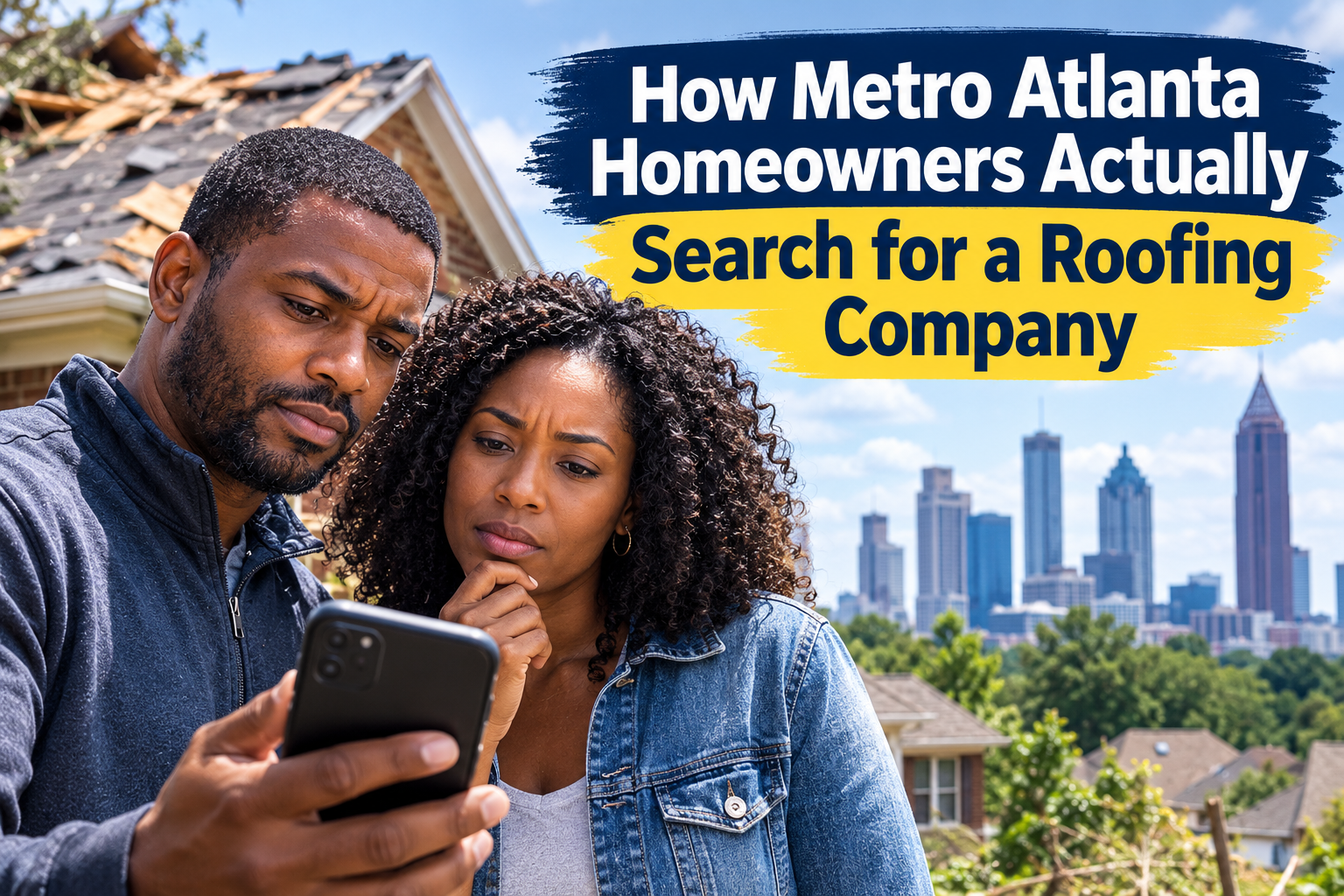
It is a Tuesday in April. Blue sky at noon. By four in the afternoon there is a severe thunderstorm warning for Cobb County, and by dinnertime hail the size of a quarter has worked its way across Kennesaw, Marietta and half of East Cobb.
By nine that night, several thousand Metro Atlanta homeowners are sitting on the couch with a phone in their hand, searching for a roofer.
Three companies show up. If you are a roofing contractor here, whether April is a good month or a brutal one comes down to whether you are one of those three. Not whether your crews are better. Not whether your warranty is stronger. Whether you were on the screen.
Here is how that search actually happens in Atlanta, why most local roofing companies are invisible for it, and what it takes to change that.
Atlanta’s Storm Calendar Is Your Search Calendar
Atlanta sits in what meteorologists call Dixie Alley, the southeastern extension of Tornado Alley, and it produces some of the most damaging hail in the country. The city ranks sixth nationally for hail insurance claims. You do not experience that as weather. You experience it as a phone that rings all at once.
According to the National Weather Service office in Peachtree City, April is the single most active month for severe hail in the metro, with peak season running March through May. Many years bring a smaller secondary peak in September and October. The broader severe weather window runs roughly April through September, when heat and humidity feed afternoon and evening storms.
What that means for a roofing company is uncomfortable. Your demand is not spread evenly across twelve months. It arrives in bursts tied to specific weather events in specific counties, and a single twenty-minute hail event can produce fifteen to forty thousand dollars of damage on one house.
And you cannot build search visibility during the storm. By the time hail is falling on Cherokee County, Google has already decided which roofing companies it trusts in that zip code. That decision was made over the previous several months, based on work somebody did in December and January.
The roofing companies that clean up in April did the work in November. That is the whole game.
Homeowners Search in Four Completely Different Ways
Roofing is not one search market. It is four. They want different things, convert on different timelines, and are worth different amounts. Most roofing websites are built for one of them.
1. The emergency searcher – right now, tonight
Water is coming through the ceiling. There is a tarp situation developing. This person searches “emergency roof repair near me,” “roof leak repair Atlanta,” or “24 hour roofer” and they are not comparing anybody. They are tapping the first result with a phone number and decent reviews.
This search is won on three things: map pack placement, review count and recency, and whether your phone number is one thumb-tap away on a mobile screen. Nothing you write matters. They are not reading.
2. The storm damage searcher – the next 72 hours
This is the big one in Atlanta. The storm passed, the homeowner walked the yard and found shingle granules by the downspout and a dented gutter. Now they are searching “hail damage roof inspection,” “storm damage roof repair Marietta,” or “free roof inspection near me.”
This searcher has time to compare, but not much. They will look at two or three companies. They are anxious, they suspect they are about to be taken advantage of, and they are deciding who seems legitimate. Reviews matter enormously, and so does whether your site looks like it belongs to a company that will still exist in three years.
3. The insurance researcher – two to six weeks
This person has damage and is trying to understand the claims process before they commit to anybody. They search things like “does insurance cover hail damage roof,” “roof insurance claim denied,” “what is a cosmetic damage exclusion,” and “do I have to pay my deductible on a roof claim.”
These are valuable searches and almost no Atlanta roofing company writes for them. A homeowner with a two percent deductible on a four hundred thousand dollar house is looking at eight thousand out of pocket before insurance contributes anything. They are frightened and looking for someone who will explain it straight.
The roofing company that publishes honest content about deductibles, adjusters, supplements, cosmetic damage exclusions and Georgia’s prompt reporting requirements becomes the trusted voice in that homeowner’s research. By the time they call, the decision is already made.
4. The retail searcher – three to twelve months
No storm. The roof is twenty-two years old, the house is going on the market next spring, or a home inspection flagged it. This person searches “roof replacement cost Atlanta,” “metal roofing contractor near me,” “architectural shingles vs 3-tab,” and “best roofing companies in Alpharetta.”
Retail work keeps crews employed between storms and it is the most neglected category in the trade. Storm chasers do not compete for it, because it requires being visible for months rather than parachuting in for two weeks. That makes it the most defensible revenue a local Atlanta roofer can build.
The Storm Chaser Problem
Within about twenty-four hours of a significant hail event in Kennesaw or Woodstock or anywhere else in the metro, out-of-state crews arrive and start knocking doors. They are organized, they are fast, and they are gone by August.
Local companies tend to respond by trying to out-knock them, which is a fight on the storm chaser’s home turf. They have more people, fewer obligations and nothing to lose.
The fight you win is search. A storm chaser has no Google Business Profile in Cobb County, no local reviews, no history and no content. When the homeowner who did not answer the door goes inside and searches instead, the storm chaser does not exist. You should.
That is the structural advantage of being local, and most Atlanta roofing companies never cash it in. It requires local SEO that is actually built out rather than a website that has been sitting untouched since 2019.
Where Atlanta Roofing Companies Are Losing
On page for the Atlanta Market
Metro Atlanta is not a market. It is dozens of them. Ranking in Buckhead does nothing for you in Douglasville. The homeowner in Marietta gets completely different results than one in Decatur, because Google weighs distance from the searcher heavily. If you serve Smyrna, Sandy Springs and six other cities from a single page that lists all of them, you have weak relevance for every one.
Hail does not fall evenly. It hits specific counties on specific days. If your visibility is concentrated in the one zip code where your office sits, you are only in business on the days the storm happens to land on top of you.
A Google Business Profile that is half filled in
The most common and most fixable problem in the trade. Services not listed. No photos in eight months. No posts. Q&A blank. Every one is a relevance signal Google uses, and most roofing profiles are missing more than half of them.
Roofing companies also have the single best photo library of any trade and almost never use it. Every completed roof is a geo-tagged ranking signal sitting unused on somebody’s phone.
Reviews that are too old
Recency beats volume. Industry research this year found that 47 percent of consumers will not use a business with fewer than 20 reviews, and 74 percent specifically look for reviews written in the last three months. A roofing company with 30 reviews from this year will generally outrank one with 200 from four years ago.
The fix is a system, not willpower. The request has to fire when the crew packs up and the homeowner is standing in the driveway looking at a finished roof, not three weeks later when somebody remembers.
A site that is too slow for a homeowner in a driveway
Most roofing searches happen on a phone, frequently outside, often with the homeowner looking up at the damage while they type. If your site takes six seconds to load or the phone number is not thumb-sized, you lost that job before you knew it existed. A website that loads fast and puts the call button where a thumb naturally sits is worth more than any amount of additional traffic.
The New Problem: Homeowners Are Asking AI First
Something changed this year that most roofing companies have not registered yet.
A year ago, roughly 6 percent of consumers used ChatGPT, Gemini or Perplexity to find a local business. In BrightLocal’s 2026 Local Consumer Review Survey that figure is 45 percent – a seven-fold jump in twelve months, making AI the third most-used source for local recommendations behind only Google and Facebook. Google’s own AI Overviews now appear on a majority of local-intent searches, frequently sitting above the map pack.
The uncomfortable part is how selective those recommendations are. SOCi’s 2026 Local Visibility Index analyzed more than 350,000 business locations and found ChatGPT recommends only about 1.2 percent of them, compared with roughly 36 percent visibility in Google’s local 3-pack for the same brands.
And rankings do not transfer. Fewer than half the businesses winning Google’s local results also appear in AI recommendations. AI systems also punish bad data harder than Google does – research found only about 68 percent of business contact details surfaced by ChatGPT and Perplexity actually match what is on the company’s Google profile. An outdated phone number does more damage in an AI answer than it does on a map.
Roughly three quarters of what AI cites about a business comes from off its own website – directories, reviews, industry listings. Which means AI search visibility is not something you fix by rewriting your homepage. It is a data consistency and reputation problem, and the roofing companies that sort it out in the next twelve months will have a real head start.
What To Do, and When
The timing matters as much as the work, because of how Atlanta’s storm season falls.
- Google Business Profile and map pack movement generally shows up within 30 to 90 days.
- Competitive organic rankings take four to nine months.
- Peak hail season is March through May, with April the heaviest month.
Work backwards and the answer is obvious. To be visible in April, the foundation has to be built by November or December. A roofing company that starts in March is buying visibility for next year’s storm season, not this one – still worth doing, but a very different conversation than most owners think they are having.
The order that works:
- Fix and fully complete the Google Business Profile. Categories, every service described, weekly photos, posts, seeded Q&A. This is free and it moves fastest.
- Build a real page for each service and each city you serve. Not one page listing twenty towns.
- Start the review engine and never stop it. Recency compounds.
- Write the insurance and cost content nobody else will write. It ranks easily and it builds trust before the call.
- Make the business data identical everywhere it appears online, which is also the foundation of AI visibility.
If you need leads before that matures, Google Ads will buy you calls this week while the organic side builds. Most roofing companies should run both for a while and then dial the paid spend back as rankings take over.
The Bottom Line
Atlanta gives roofing companies something most markets do not: reliable, weather-driven, high-ticket demand that arrives every single spring. Sixth in the nation for hail claims is a hard year for homeowners and a good one for roofers who are findable.
The companies that capture it are not the ones with the best crews. They are the ones already there when the homeowner picked up the phone. That position gets built months in advance, in the quiet part of the year, by owners who treat their online presence like equipment rather than an expense.
Get Found Atlanta works with roofing and tree service companies across Metro Atlanta on exactly this. If you want to see where your company actually ranks across your service area, who is beating you in which cities, and what it would take to change that before next storm season, get in touch or request a free visibility report. Ten minutes, no obligation, and it is yours to keep either way. You can also start with a free site audit if you would rather just see what is broken first.